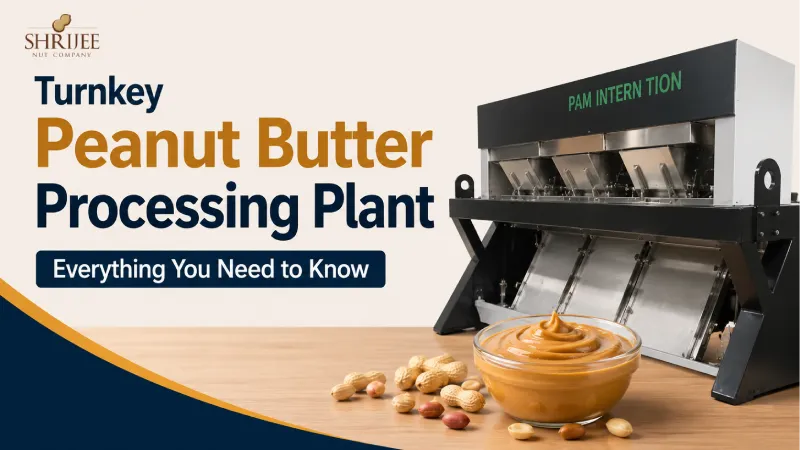
Key Takeaways
- Learn how turnkey peanut butter processing plants streamline production from raw peanuts to final packaging.
- Understand the importance of partnering with a reliable turnkey peanut butter plant manufacturer in India.
- Discover the key components essential for an efficient peanut butter manufacturing process.
- Explore the benefits of investing in turnkey solutions for faster implementation and improved product quality.
- Recognize the growing demand for peanut butter due to health trends and consumer preferences.
The peanut butter industry has witnessed remarkable growth across domestic and international markets due to increasing demand for nutritious, protein-rich, and convenient food products. Entrepreneurs and food processing companies are actively investing in peanut butter manufacturing because of its strong market potential and growing consumer acceptance. Setting up a complete peanut butter production facility requires advanced machinery, proper process planning, quality control systems, and technical expertise. This is where a turnkey peanut butter processing plant becomes an ideal solution.
A turnkey peanut butter processing plant offers an end-to-end manufacturing setup designed to streamline the entire production process from raw peanut handling to final packaging. Businesses looking for a reliable and efficient production system often prefer working with an experienced Turnkey peanut butter plant manufacturer in India to achieve operational efficiency, consistent product quality, and long-term profitability.Shrijee Nut Company specializes in providing advanced turnkey peanut butter processing solutions that help manufacturers establish modern and productive facilities. With years of expertise in nut processing technologies, Shrijee Nut Company delivers customized systems designed to meet diverse production requirements.
What is a Turnkey Peanut Butter Processing Plant?
A turnkey peanut butter processing plant is a full-featured manufacturing solution which includes all the peanut butter manufacturing processes in a single project. The supplier design, manufacture, install, test, commission and provide technical support for the equipment, the client concentrates on production and business development.
The turnkey plant idea takes the hassle out of purchasing equipment from various suppliers. Rather, manufacturers will get a complete facility that's prepared for use. This makes dry processing with a reputable Turnkey peanut butter plant manufacturer in India easier and ensures quality control during manufacturing.These plants are engineered for processing peanuts to smooth, creamy or crunchy peanut butter products that meet hygiene, efficiency and food safety standards.
Growing Demand for Peanut Butter Manufacturing Plants
Peanut butter is a very popular food product these days because of its numerous benefits. Health-conscious foodies, athletes, fitness lovers and families looking for healthy food options have all turned to peanut butter as a food choice. Peanut butter makers are seeing new opportunities because of the demand for spreads and plant-based food options that are rich in protein.
Several factors contribute to the growing popularity of peanut butter:
- Increasing awareness of protein-rich diets
- Rising demand for healthy breakfast options
- Growing consumption of plant-based products
- Expanding food processing industry
- Increasing export opportunities
Thus, companies are looking for a reliable Turnkey peanut butter plant manufacturer in India to set up efficient peanut butter manufacturing units to produce peanut butter to meet the demand of the market.
Key Components of a Turnkey Peanut Butter Processing Plant
Most peanut butter processing plants have a number of specialized machines that are used to make peanut butter.
1. Peanut Cleaning System
The process starts by cleaning raw peanuts, which involves dust, stones, foreign materials and impurities are cleaned. By effectively cleaning, product quality is enhanced and protection is provided for downstream equipment.
2. Roasting Equipment
One of the most important steps in peanut butter production is roasting. Good roast brings out flavor, aroma, texture, and color, and it eliminates moisture.
3. Cooling System
The roasted peanuts are then cooled to preserve the product quality and ready for further processing.
4. Blanching Machine
To remove the skins of peanuts and to give the product a smooth texture, blanching is done.
5. Sorting Equipment
Sorting systems remove defective kernels and ensure uniformity of product quality.
6. Grinding and Milling System
Peanuts are processed into a fine paste by highly sophisticated grinding machine. There can be more than one grinding stage to get the desired texture and consistency.
7. Mixing System
Other ingredients like salt, sugar, stabilizers and/or flavorings can be mixed into the peanut paste as required by the product.
8. Storage Tanks
Processed peanut butter is temporarily stored in hygienic tanks before packaging them.
9. Filling and Packaging Machine
Automated filling systems are used to package peanut butter into jars, containers, pouches, or any other unique packaging method.All of these integrated systems are provided by a reputed Turnkey peanut butter plant manufacturer in India to establish a seamless environment of production.
Peanut Butter Manufacturing Process
Understanding the manufacturing process helps businesses evaluate production requirements and operational efficiency.
Raw Material Reception
High-quality peanuts are selected and received for processing. Quality inspection is conducted before production begins.
Cleaning
Peanuts pass through cleaning systems that remove contaminants and unwanted materials.
Roasting
The peanuts are roasted under controlled temperature conditions to develop the desired flavor profile.
Cooling
Roasted peanuts are cooled to preserve quality and prevent over-processing.
Blanching and Sorting
Skins are removed, and kernels are inspected to eliminate defective peanuts.
Grinding
Peanuts are ground into a fine paste using advanced milling systems.
Mixing
Ingredients are added according to formulation requirements.
Homogenization
The mixture is processed to achieve uniform texture and consistency.
Packaging
Finished peanut butter is filled into containers and prepared for distribution.This integrated production process forms the foundation of a successful turnkey peanut butter processing plant.
Benefits of Choosing a Turnkey Peanut Butter Processing Planty
Investing in a turnkey solution offers several operational and business advantages.
Faster Project Implementation
Installation and commissioning can be more efficiently carried out as all work is handled by one supplier.
Reduced Operational Complexity
Coordinating and communicating in projects becomes easier with a single point of responsibility.
Consistent Product Quality
An integrated system aids in product uniformity and manufacturing quality.
Better Production Efficiency
Automated equipment increases the throughput and minimizes manual handling.
Scalability
Future plant expansion is possible with modern turnkey plants.
Technical Support
A reputed peanut butter plant manufacturer in India offers technical advice, training for operators and post sales service.
Important Factors When Selecting a Peanut Butter Plant
Choosing the right manufacturing partner plays a major role in project success.
Production Capacity
Evaluate daily and annual production requirements before selecting equipment.
Product Range
Determine whether the facility will produce smooth, crunchy, flavored, or specialty peanut butter products.
Automation Level
Advanced automation can improve productivity and reduce labor requirements.
Food Safety Standards
The plant should comply with industry hygiene and quality standards.
Energy Efficiency
Efficient equipment can help reduce operational costs.
Service Support
Reliable technical assistance and spare parts availability are essential for uninterrupted production.
Working with an established Turnkey peanut butter plant manufacturer in India can help businesses make informed investment decisions.
Applications for Peanut Butter Processing Plants
Peanut butter processing plants support a wide range of industries and applications.
Food Manufacturing Industry
Used for producing commercial peanut butter products for retail and wholesale markets.
Bakery Industry
Peanut butter serves as an ingredient in cookies, cakes, pastries, and desserts.
Confectionery Industry
Chocolate and candy manufacturers use peanut butter in various formulations.
Health and Nutrition Sector
Peanut butter is widely consumed as a protein-rich food product.
Export Businesses
Manufacturers produce peanut butter for international distribution and export markets.These applications highlight the versatility and business potential of modern peanut butter manufacturing facilities.
Why Choose Us
Shrijee Nut Company has established itself as a dependable provider of peanut butter production and processing solutions. The company's main business is to provide turnkey projects tailored to particular production objectives and operating needs. Shrijee Nut Company has been in the business of food processing technology for many years, providing you with the latest equipment, project management, technical expertise and reliable service. When companies work with Shrijee Nut company, they can experience top-notch engineering, dependable plant performance, and effective manufacturing systems, as well as a dedication to customer contentment. Shrijee Nut Company collaborates with its clients throughout the entire project lifecycle, from initial design to commissioning, to develop profitable and sustainable peanut butter processing plants that look to long-term success.
Conclusion
Owning a turnkey peanut butter processing plant is an efficient and practical solution for businesses that are looking to start or expand peanut butter manufacturing. Cleaning, roasting, grinding, mixing, storage and packaging are all integrated into one production line, thereby improving productivity, quality consistency and improving the operation of the production line. Choosing the right peanut butter plant manufacturer in India is an essential factor in creating a successful peanut butter production plant. Shrijee Nut Company provides advanced technology, industry experience and custom solutions to help companies build a dependable peanut butter production facility that can help them meet market demand and grow the business in the long term.
Looking to establish a high-performance turnkey peanut butter processing plant? Contact Shrijee Nut Company today at +91 999 896 3963 or email shrijeenut@gmail.com.
Frequently Asked Questions
What is a turnkey peanut butter processing plant?
A turnkey peanut butter processing plant is a comprehensive manufacturing solution that includes all necessary equipment and processes for peanut butter production. It simplifies setup by providing a complete facility that is ready for immediate use.
Why should I choose a turnkey peanut butter plant manufacturer in India?
Choosing a turnkey peanut butter plant manufacturer in India, like Shrijee Nut Company, ensures you receive expert guidance, reliable equipment, and comprehensive support throughout the project lifecycle. This helps achieve operational efficiency and consistent product quality.
What are the key components of a peanut butter processing plant?
Key components include a peanut cleaning system, roasting equipment, cooling systems, grinding and milling systems, and packaging machines. Each component plays a crucial role in ensuring the efficient production of high-quality peanut butter.
How does the manufacturing process of peanut butter work?
The peanut butter manufacturing process involves several stages: raw material reception, cleaning, roasting, cooling, blanching, grinding, mixing, homogenization, and packaging. This integrated approach ensures that the final product meets quality and safety standards.
What benefits come from investing in a turnkey peanut butter processing plant?
Investing in a turnkey peanut butter processing plant offers advantages such as faster project implementation, reduced operational complexity, consistent product quality, and improved production efficiency. These benefits ultimately lead to long-term profitability.