Peanut Butter Machine Manufacturer in Chennai
Peanut butter processing machinery for Chennai food manufacturers — roasters, blanchers, grinders and filling systems in food-grade stainless steel, delivered and commissioned across Ambattur, Sriperumbudur, Oragadam and Gummidipoondi.
- Power
- 415V 3-phase, 50Hz standard
- Capacity
- 100 – 1,000+ kg/day
- Construction
- SS304 standard, SS316 optional
- Coverage
- Ambattur, Sriperumbudur, Oragadam, Gummidipoondi, Maraimalai Nagar
- Road Transit
- 3–4 days from Rajkot
- Included
- Installation, commissioning & training
Peanut Butter Machines
for Chennai
Chennai is the only major Indian metro that combines a large urban market, a serious port and a groundnut-growing hinterland in its own state. Tamil Nadu produces the crop across Tiruvannamalai, Villupuram, Salem, Namakkal and Dharmapuri, and groundnut is deeply embedded in the regional diet — which means a packaged peanut butter brand here is extending a familiar ingredient rather than introducing a new one.
We manufacture the machinery at Jam Kandorna in Rajkot district, Gujarat. More than 500 machine installations and over 100 turnkey projects across 25+ states since 2004, with installation, commissioning and operator training included as standard.
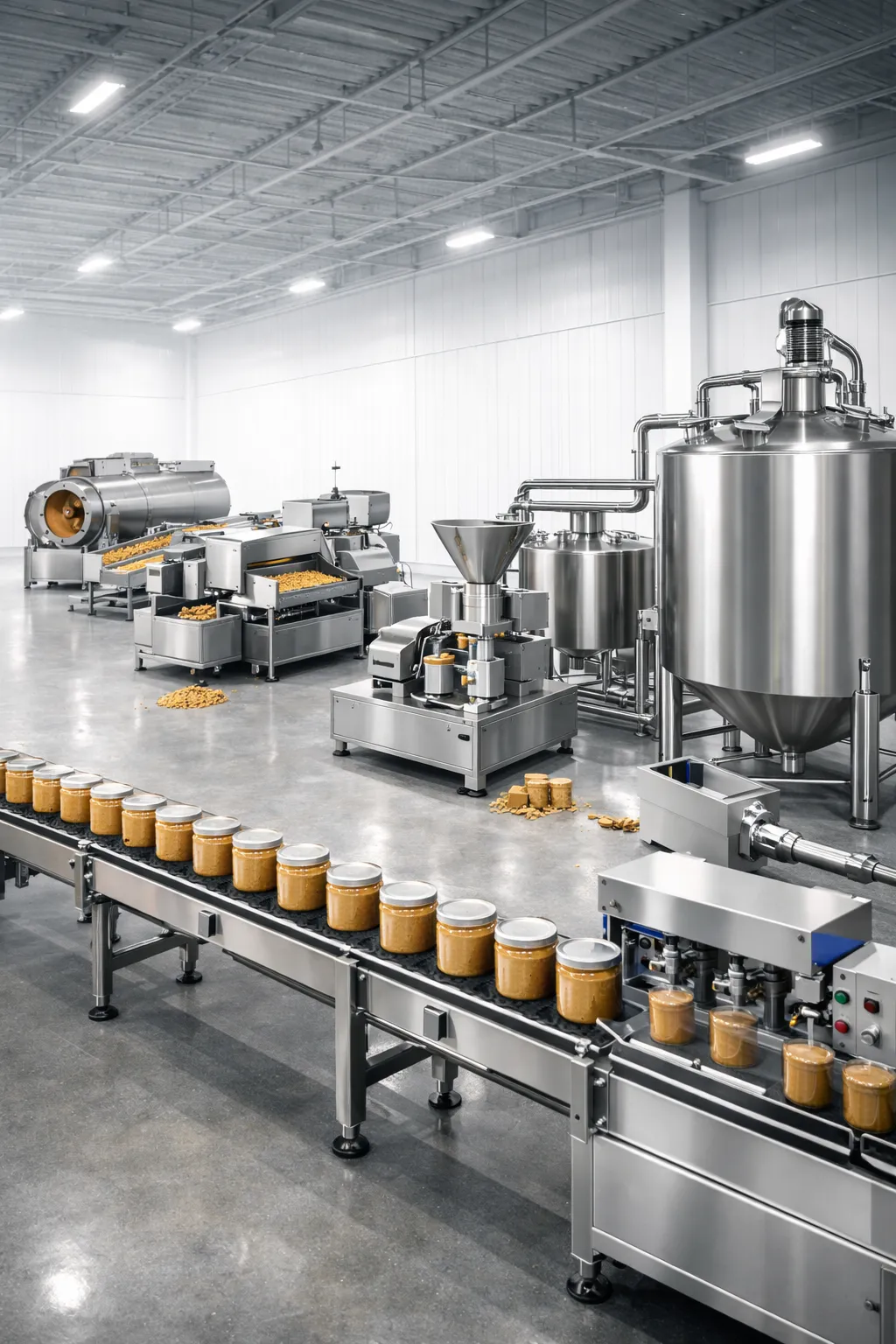
From Raw Groundnut to Filled Jar
Order the full sequence as one integrated package, or individual machines to fill gaps in an existing setup.
Every Machine We Manufacture
Twenty machines across six categories — supplied individually or as a fully integrated line.
Choose Capacity for Your Market
Over-specifying is the most common and most expensive mistake we see. Buy for the demand you can prove, not the demand you hope for.
Starter Line
100–150 kg/dayNew brand serving Chennai retail, health-food outlets and online channels.
- Compact roaster
- Single-stage grinding
- Semi-automatic filling
- 800–1,200 sq ft footprint
Growth Line
300–500 kg/dayEstablished brand supplying modern trade across Tamil Nadu and the south.
- Rotary roaster and cooling belt
- Blanching stage included
- Two-stage grinding
- 2,500–4,000 sq ft footprint
Industrial Line
1,000+ kg/dayContract or private-label manufacturer, or exporter through Chennai and Kamarajar ports.
- Continuous roasting
- Automated blanching
- In-line filling and labelling
- Bulk storage tanks
Chennai is the south’s export gateway, so decide early whether that matters. If Sri Lanka, Southeast Asia or the Gulf are part of the plan, specify FSSAI Central licensing and export-grade packaging and coding from the start. Retrofitting a line for export is considerably more expensive than building it in.
Machinery is supplied nationwide from our Rajkot works — only freight to site differs. Budget separately for premises, pollution-board consent, electrical load sanction, internal wiring and civil work. See our plant investment guide, profit margin analysis and automation comparison.
Four Reasons Chennai
Works as a Production Base
Groundnut in the State
Tamil Nadu grows the crop across Tiruvannamalai, Villupuram, Salem, Namakkal and Dharmapuri. Supply is in-state, which is unusual for a coastal metro.
Familiar Ingredient
Groundnut is deeply embedded in the regional diet, so a packaged brand here extends something consumers already buy rather than introducing an unfamiliar category.
Port on the Doorstep
Chennai Port and Kamarajar at Ennore make export practical from day one. Sri Lanka and Southeast Asia are short routings.
Industrial Depth
The Sriperumbudur–Oragadam corridor carries some of India’s best-organised manufacturing infrastructure, with contractors and skilled labour readily available.
Setting Up in Chennai
The order these happen in matters. Pollution-board consent and load sanction routinely take longer than machine manufacture.
Secure the Plot
SIPCOT and SIDCO estates at Sriperumbudur, Oragadam, Ambattur or Gummidipoondi are the usual route — confirm the plot permits food processing before committing.
Registrations
FSSAI, GST, Udyam and the local trade or factory licence.
Consent & Load
Apply to the Tamil Nadu Pollution Control Board for consent and to TANGEDCO for sanctioned load.
Civil & Electrical
Flooring, drainage and wiring completed against our layout and foundation drawings.
Delivery & Commissioning
3–4 day road transit from our Rajkot works, then installation and operator training on site.
Apply for load sanction early. We issue a connected-load schedule with every quotation precisely so you can start this before the machines are built. Metering and sanction routinely take longer than manufacture, and it is the most common reason commissioning slips.
Siting a Peanut Butter
Plant in Chennai
The city’s industrial land runs in corridors out along the highways, and each has a different cost and access profile.
Ambattur & Gummidipoondi
Ambattur is the established inner estate, close to the labour pool with lower entry costs. Gummidipoondi on the northern corridor offers larger plots.
Sriperumbudur & Oragadam
The western corridor carries the best-organised industrial infrastructure in the region, with developed plots and dependable supply — and good access to both port and highway.
Space You Will Need
A 100–150 kg/day line needs roughly 800–1,200 sq ft; a 500 kg/day line 2,500–4,000 sq ft. Budget separately for a dry, ventilated raw material store — coastal humidity makes this matter more here.
Sourcing and Delivery
Tamil Nadu grows its own groundnut across Tiruvannamalai, Villupuram, Salem, Namakkal and Dharmapuri, with Anantapur in neighbouring Andhra Pradesh available for volume or a different grade.
- In-state supply is a genuine advantage for a coastal metro — most comparable cities haul kernels several hundred kilometres.
- Coastal humidity works against you after roasting. Cooling-belt residence time and sealed storage matter more in Chennai than at an inland site; we specify for the actual location.
- Aflatoxin management starts at intake. Keep the sorting table and vibratory sieve in the machine list rather than trusting supplier grading.
- Machinery delivery from our Rajkot works is roughly three to four days by road, with the commissioning team following.
Licences for a Chennai Unit
- FSSAI manufacturing licence — State licence for most units; Central licence above the turnover threshold or if you plan to export.
- GST and Udyam (MSME) registration — the latter unlocks most subsidy and priority-lending schemes.
- Tamil Nadu Pollution Control Board consent to establish and consent to operate.
- Factory licence from the state labour department, plus fire NOC depending on built-up area.
- Legal Metrology packer registration if you sell pre-packaged retail — it governs how your label declares net quantity.
Rules and thresholds change periodically. Treat this as an orientation checklist, not a compliance reference, and confirm the current position with a local consultant. Our guide to FSSAI compliance for peanut butter manufacturers covers the food-safety side in depth.
Power & Load Planning
Chennai runs standard 415V three-phase 50Hz supply through TANGEDCO. Industrial supply across the SIPCOT estates is dependable, so most units size a backup set for grinding and filling only rather than the full load.
| Line capacity | Indicative connected load |
|---|---|
| 100–150 kg/day | 15 – 25 kW |
| 300–500 kg/day | 40 – 60 kW |
| 1,000+ kg/day | 85 – 130 kW |
Peanut Butter Machines in Chennai
Yes. We manufacture at our Rajkot, Gujarat facility and deliver across Chennai. Road transit is approximately 1,800–2,000 km and typically takes three to four days once the machine is dispatched. Installation, commissioning and operator training are part of our standard supply.
Typically an FSSAI manufacturing licence, GST registration, Udyam (MSME) registration, a factory or trade licence from the local authority, and consent to establish and operate from the Tamil Nadu Pollution Control Board. Legal Metrology packer registration applies if you sell pre-packaged retail. Requirements change periodically, so verify current rules with a local consultant.
SIPCOT and SIDCO estates are the usual route. Ambattur is the established inner estate, close to the labour pool with lower entry costs, while Gummidipoondi on the northern corridor offers larger plots. The Sriperumbudur and Oragadam corridor carries the best-organised industrial infrastructure with good access to both port and highway.
Standard Indian 415V three-phase 50Hz. A 100–150 kg/day line typically needs 15–25 kW sanctioned load; a 300–500 kg/day line generally needs 40–60 kW; a 1,000 kg/day line 85–130 kW. We issue a connected-load schedule with every quotation so you can apply for the correct sanctioned load before the machines arrive.
Yes, as part of our standard supply. Training covers roast profiling, grinder gap setting, cleaning and changeover routines, and preventive maintenance. Layout and foundation drawings are supplied ahead of delivery so civil and electrical work can be completed before the machines arrive.
It affects the stages after roasting more than the machinery. Humid air slows cooling and shortens the useful window before grinding, and it works against finished-product shelf life if storage is not sealed properly. We size cooling-belt residence time for the actual plant location rather than a generic default, and advise on storage accordingly — tell us where the site is when you enquire.
Within Tamil Nadu for the most part — Tiruvannamalai, Villupuram, Salem, Namakkal and Dharmapuri all grow it — with Anantapur in neighbouring Andhra Pradesh available for volume or a different grade. In-state supply is a real advantage for a coastal metro; most comparable cities haul kernels several hundred kilometres.
Planning a Peanut Butter Plant in Chennai?
Tell us your target output, packaging format, whether you need smooth, crunchy or both, and whether export is part of the plan. We will come back with a machine list, a layout drawing and a firm price.