Peanut Butter Machine Manufacturer in Ahmedabad
Peanut butter processing machinery for Ahmedabad food businesses — roasters, blanchers, grinders and filling systems in food-grade stainless steel, delivered and commissioned across Sanand, Changodar, Vatva, Naroda and Odhav.
- Power
- 415V 3-phase, 50Hz standard
- Capacity
- 100 – 1,000+ kg/day
- Construction
- SS304 standard, SS316 optional
- Coverage
- Sanand, Changodar, Vatva, Naroda, Odhav, Kadi
- From Our Works
- Same-state, about a day
- Included
- Factory visit, installation & training
Peanut Butter Machines
for Ahmedabad
Ahmedabad is where Gujarat’s groundnut turns into a brand. The city carries the state’s largest consumer market, its deepest retail and distribution network, and a food-processing base that has been consolidating in the Sanand and Changodar corridors for two decades. It is far enough from the Saurashtra mandis to need a supply plan, and close enough that the plan is easy.
We manufacture the machinery at Jam Kandorna in Rajkot district, roughly a day’s haul away. More than 500 machine installations and over 100 turnkey projects since 2004, and Ahmedabad buyers are welcome to see a line running at the works before committing.
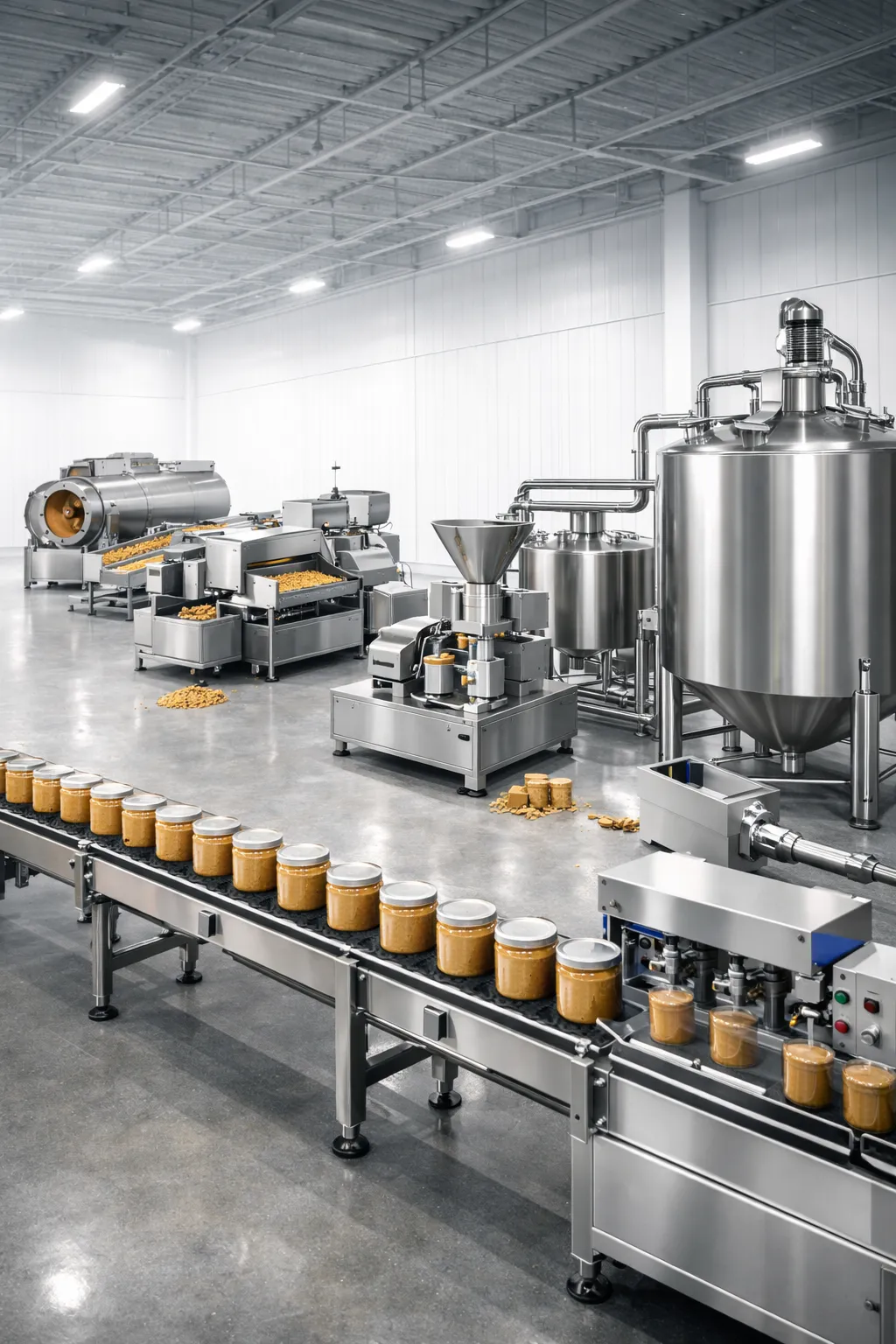
From Raw Groundnut to Filled Jar
Order the full sequence as one integrated package, or individual machines to fill gaps in an existing setup.
Every Machine We Manufacture
Twenty machines across six categories — supplied individually or as a fully integrated line.
Choose Capacity for Your Market
Over-specifying is the most common and most expensive mistake we see. Buy for the demand you can prove, not the demand you hope for.
Starter Line
100–150 kg/dayD2C brand, health-food retail and quick-commerce listings across the city.
- Compact roaster
- Single-stage grinding
- Semi-automatic filling
- 800–1,200 sq ft footprint
Growth Line
300–500 kg/dayEstablished brand supplying modern trade across Gujarat and western India.
- Rotary roaster and cooling belt
- Blanching stage included
- Two-stage grinding
- 2,500–4,000 sq ft footprint
Industrial Line
1,000+ kg/dayContract and private-label manufacturing, or export through Mundra and Kandla.
- Continuous roasting
- Automated blanching
- In-line filling and labelling
- Bulk storage tanks
Ahmedabad’s advantage is the market, not the crop. You are buying kernels from Saurashtra either way, so specify intake grading properly rather than assuming mandi quality travels. What the city gives you is somewhere to sell — and a packaging, printing and labelling supply chain within the ring road.
Machinery is supplied from our Rajkot works, so freight to a Gujarat site is a short haul rather than a line item that matters. Budget instead for premises, GPCB consent, electrical load sanction, internal wiring and civil work. See our plant investment guide, profit margin analysis and automation comparison.
Four Reasons Ahmedabad
Works as a Production Base
Gujarat’s Largest Market
Modern trade, a maturing D2C base and strong quick-commerce coverage all sit here. A brand can test, iterate and scale inside one city before committing to state-wide distribution.
Distribution Reach
Ahmedabad is the natural hub for north Gujarat, Rajasthan and Madhya Pradesh, on some of the best road infrastructure in the country.
Packaging Supply Chain
Jars, caps, labels, cartons and contract printing are all available locally, which shortens lead times and frees up working capital otherwise tied into packaging inventory.
Export Corridor
Mundra and Kandla are within reach. If private-label or Gulf export is part of the plan, specify FSSAI Central licensing and export-grade packaging from the start.
Setting Up in Ahmedabad
The order these happen in matters. GPCB consent and load sanction routinely take longer than machine manufacture.
Secure the Plot
GIDC Sanand, Changodar, Vatva, Naroda or Odhav are the usual choices — confirm the plot permits food processing before committing.
Registrations
FSSAI, GST, Udyam and the local trade or factory licence.
GPCB & Load
Apply to the Gujarat Pollution Control Board for consent and to Torrent Power or UGVCL for sanctioned load.
Civil & Electrical
Flooring, drainage and wiring completed against our layout and foundation drawings.
Delivery & Commissioning
1–2 day road transit from our Rajkot works, then installation and operator training on site.
Worth the drive before you commit. The works is at Jam Kandorna in Rajkot district, a comfortable day trip from Ahmedabad. Most buyers who make the trip change at least one thing in their specification after seeing a line run — usually the filler or the blender size.
Siting a Peanut Butter
Plant in Ahmedabad
The city’s industrial land splits between the older inner estates and the newer western corridor, and the choice affects both rent and staffing.
Sanand & Changodar
Sanand and Changodar on the western corridor carry most new food processing investment — developed plots, dependable supply and room to expand.
Vatva, Naroda & Odhav
The older estates sit closer to the city and the labour pool, with lower entry costs but tighter plots. Vatva and Naroda remain practical for a first unit.
Space You Will Need
A 100–150 kg/day line needs roughly 800–1,200 sq ft; a 500 kg/day line 2,500–4,000 sq ft. Budget separately for a dry, ventilated raw material store.
Sourcing and Delivery
Ahmedabad does not grow groundnut — Saurashtra does. Kernels come in from the Rajkot, Gondal, Junagadh and Jamnagar mandis, roughly 200–300 km west, either direct from traders or through Ahmedabad’s wholesale market.
- Buy direct from Saurashtra traders where volume allows. Grade and moisture consistency improve noticeably against buying through the city trade, and it shows up immediately in roast consistency.
- Plan for a half-day inbound leg. It is short by Indian standards but long enough that monsoon-season moisture needs watching — covered transport is worth the premium.
- Aflatoxin management starts at intake. Keep the sorting table and vibratory sieve in the machine list rather than trusting supplier grading.
- Machinery delivery from our Rajkot works is same-state and typically takes about a day.
Licences for an Ahmedabad Unit
- FSSAI manufacturing licence — State licence for most units; Central licence above the turnover threshold or if you plan to export.
- GST and Udyam (MSME) registration — the latter unlocks most subsidy and priority-lending schemes.
- GPCB consent to establish and consent to operate from the Gujarat Pollution Control Board.
- Factory licence from the state labour department, plus fire NOC depending on built-up area.
- Legal Metrology packer registration if you sell pre-packaged retail — it governs how your label declares net quantity.
Rules and thresholds change periodically. Treat this as an orientation checklist, not a compliance reference, and confirm the current position with a local consultant. Our guide to FSSAI compliance for peanut butter manufacturers covers the food-safety side in depth.
Power & Load Planning
Ahmedabad runs standard 415V three-phase 50Hz supply through Torrent Power in the city and UGVCL in the surrounding districts. Supply is reliable, so most units size a backup set for grinding and filling only rather than the full load.
| Line capacity | Indicative connected load |
|---|---|
| 100–150 kg/day | 15 – 25 kW |
| 300–500 kg/day | 40 – 60 kW |
| 1,000+ kg/day | 85 – 130 kW |
Peanut Butter Machines in Ahmedabad
Yes. We manufacture at our Rajkot, Gujarat facility and deliver across Ahmedabad. Road transit is approximately a same-state haul of 200–250 km and typically takes about a day once the machine is dispatched. Installation, commissioning and operator training are part of our standard supply.
Typically an FSSAI manufacturing licence, GST registration, Udyam (MSME) registration, a factory or trade licence from the local authority, and consent to establish and operate from the Gujarat Pollution Control Board. Legal Metrology packer registration applies if you sell pre-packaged retail. Requirements change periodically, so verify current rules with a local consultant.
Sanand and Changodar on the western corridor carry most new food processing investment, with developed plots and room to expand. The older inner estates — Vatva, Naroda and Odhav — sit closer to the city and the labour pool with lower entry costs but tighter plots.
Standard Indian 415V three-phase 50Hz. A 100–150 kg/day line typically needs 15–25 kW sanctioned load; a 300–500 kg/day line generally needs 40–60 kW; a 1,000 kg/day line 85–130 kW. We issue a connected-load schedule with every quotation so you can apply for the correct sanctioned load before the machines arrive.
Yes, as part of our standard supply. Training covers roast profiling, grinder gap setting, cleaning and changeover routines, and preventive maintenance. Layout and foundation drawings are supplied ahead of delivery so civil and electrical work can be completed before the machines arrive.
It depends which end you optimise. Saurashtra gives you same-day kernel supply and the tightest batch consistency; Ahmedabad gives you the market, the packaging supply chain and better onward distribution. Brands that sell mostly within Gujarat and the north usually choose Ahmedabad and buy graded kernels from Saurashtra traders. Processors selling in bulk or contract-manufacturing usually go the other way.
Yes. Our works is at Jam Kandorna in Rajkot district, a few hours from Ahmedabad. You can walk the floor, see a line under load, and bring your own kernel sample so you judge the actual output texture rather than a specification sheet.
Planning a Peanut Butter Plant in Ahmedabad?
Tell us your target output, packaging format, whether you need smooth, crunchy or both, and your site corridor. We will come back with a machine list, a layout drawing and a firm price.