Peanut Butter Machine Manufacturer in Bengaluru
Complete peanut butter processing machinery for Bengaluru food brands — roasters, blanchers, grinders and filling systems in food-grade stainless steel, delivered, installed and commissioned across Peenya, Bommasandra, Jigani, Harohalli and Nelamangala.
- Power
- 415V 3-phase, 50Hz standard
- Capacity
- 100 – 1,000+ kg/day
- Construction
- SS304 standard, SS316 optional
- Coverage
- Peenya, Bommasandra, Jigani, Harohalli, Nelamangala
- Road Transit
- 3 – 4 days from Rajkot
- Included
- Installation, commissioning & training
Peanut Butter Machines
for Bengaluru
Bengaluru is where India’s health-food category actually gets built. The city has the deepest concentration of D2C food brands, the most established quick-commerce infrastructure and a consumer base that reads labels — which is precisely the market that turned high-protein, no-added-sugar peanut butter into a mainstream product rather than a niche one.
It also sits close to India’s largest groundnut district. Anantapur is roughly 200 km north, with Chitradurga and Tumakuru closer still. Shrijee Nut Company manufactures the processing machinery at our Rajkot works, with more than 500 machine installations and over 100 turnkey projects across 25+ Indian states since 2004.
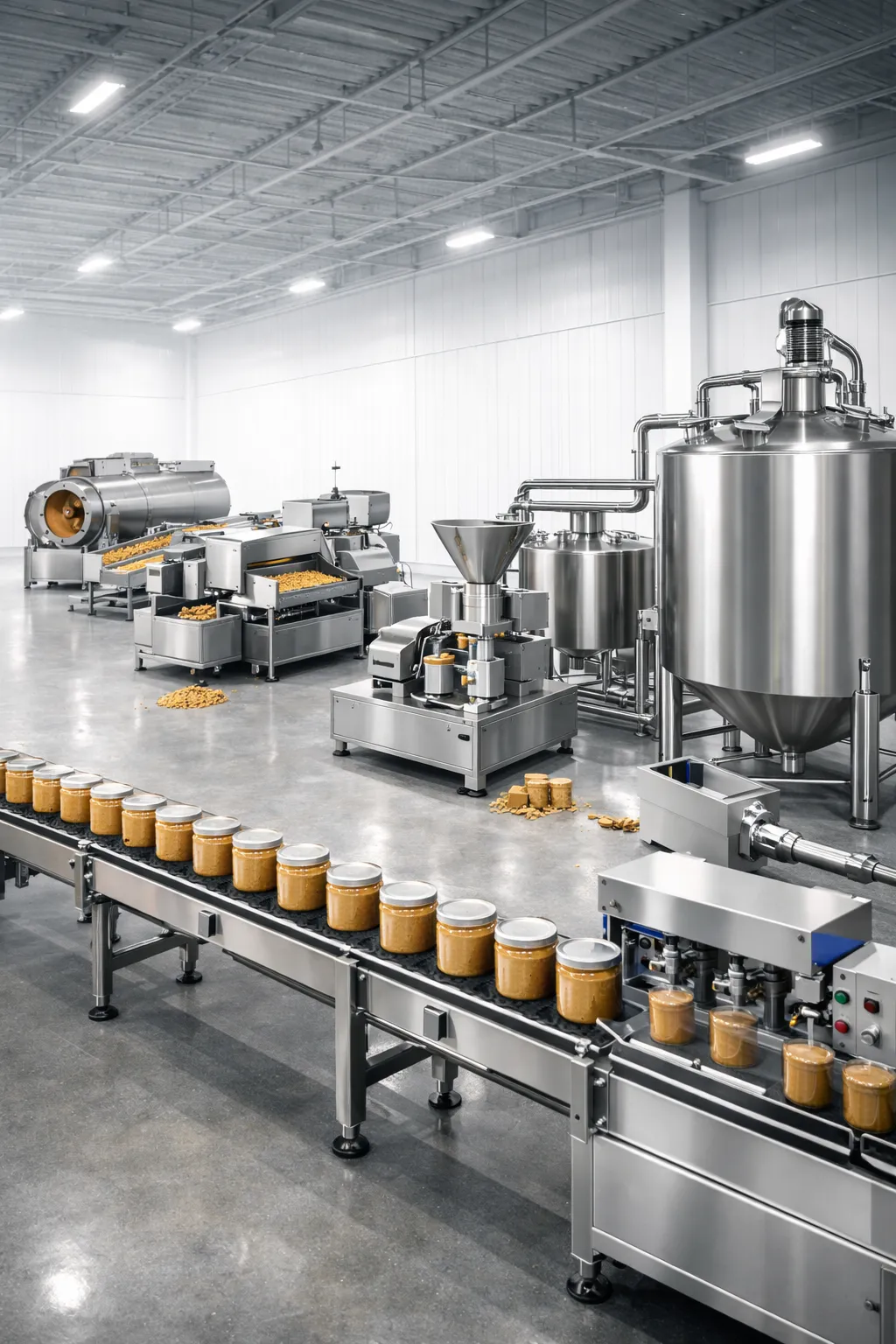
From Raw Groundnut to Filled Jar
Order the full sequence as one integrated package, or individual machines to fill gaps in an existing setup.
Every Machine We Manufacture
Twenty machines across six categories — supplied individually or as a fully integrated line.
Choose Capacity for Your Market
Over-specifying is the most common and most expensive mistake we see. Buy for the demand you can prove, not the demand you hope for.
Starter Line
100–150 kg/dayD2C brand launching on quick-commerce and marketplace channels.
- Compact roaster
- Single-stage grinding
- Semi-automatic filling
- 800–1,200 sq ft footprint
Growth Line
300–500 kg/dayEstablished brand entering modern trade across South India.
- Rotary roaster and cooling belt
- Blanching stage included
- Two-stage grinding
- 2,500–4,000 sq ft footprint
Industrial Line
1,000+ kg/dayContract manufacturer serving multiple D2C labels from one facility.
- Continuous roasting
- Automated blanching
- In-line filling and labelling
- Bulk storage tanks
Bengaluru’s dynamic is SKU proliferation, not volume. A typical D2C peanut butter brand here runs smooth, crunchy, unsweetened, chocolate and high-protein variants across three jar sizes — fifteen SKUs off one line. Specify for changeover speed rather than raw throughput: a ribbon blender sized to your smallest economic batch will do more for margin than a larger grinder.
Machinery is supplied nationwide from our Rajkot works — only freight to site differs. Budget separately for premises, pollution-board consent, electrical load sanction, internal wiring and civil work including flooring and drainage. See our plant investment guide, profit margin analysis and automation comparison.
Four Reasons Bengaluru Works
as a Production Base
The D2C Ecosystem
Brand builders, packaging designers, performance marketers, 3PL and quick-commerce dark stores are all concentrated here. For a food brand, that surrounding infrastructure is worth as much as the plant itself.
Close to Anantapur
India’s largest groundnut district is roughly 200 km away, with Chitradurga and Tumakuru closer still. Short inbound haul means less moisture drift in transit and steadier roasting.
Label-Literate Demand
Bengaluru consumers pay a premium for no-added-sugar, high-protein and single-ingredient claims. Those products need tighter grinding control and better blending, which is a specification decision at purchase, not a process tweak later.
South India Distribution
A plant here serves Karnataka, Tamil Nadu, Andhra Pradesh, Telangana and Kerala without a second facility, and Chennai port is available if export follows.
Setting Up in Bengaluru
The order these happen in matters. Pollution-board consent and load sanction routinely take longer than machine manufacture.
Secure the Plot
KIADB and KSSIDC estates are the usual route; confirm the plot permits food processing before committing.
Registrations
FSSAI, GST, Udyam and the local trade or factory licence.
KSPCB & Load
Apply to the Karnataka State Pollution Control Board for consent and to Bescom for sanctioned load.
Civil & Electrical
Flooring, drainage and wiring completed against our layout and foundation drawings.
Delivery & Commissioning
3–4 day road transit from Rajkot, then installation and operator training on site.
Apply for load sanction early. We issue a connected-load schedule with every quotation precisely so you can start this before the machines are built. Metering and sanction routinely take longer than manufacture, and it is the most common reason commissioning slips.
Siting a Peanut Butter
Plant in Bengaluru
Bengaluru’s industrial estates ring the city, and which ring you pick affects both rent and how easily your team can get there.
Established Estates
Peenya is the oldest and best-connected industrial area with a deep fabrication and maintenance ecosystem. Bommasandra and Jigani on the southern side carry a lot of the newer food processing activity.
Outer Ring Options
Harohalli, Nelamangala and the Hoskote belt offer materially lower rent with developed plots and three-phase supply. Further out means cheaper space but a harder commute for skilled staff — a real retention factor in this city.
Space You Will Need
A 100–150 kg/day line needs roughly 800–1,200 sq ft including storage, processing and packing. A 500 kg/day line needs 2,500–4,000 sq ft. Multi-SKU D2C operations should add packing and staging space beyond that baseline.
Sourcing and Delivery
Bengaluru sits closer to a major groundnut belt than any other South Indian metro. Anantapur in Andhra Pradesh is India’s largest producing district at roughly 200 km, with Chitradurga and Tumakuru inside Karnataka closer still.
- Proximity is a quality advantage, not just a freight saving. A short inbound leg means less moisture drift in transit, which means less re-profiling of the roaster between batches.
- Bold and TJ varieties behave differently. If you switch grade between seasons, expect to re-tune roast time — worth agreeing a consistent grade with your supplier instead.
- Aflatoxin management starts at intake. Do not delete the sorting table and vibratory sieve to save on the machine list — rejecting kernels at intake is far cheaper than a failed FSSAI test on finished stock.
- Road transit from our Rajkot works is roughly 1,600 km, typically three to four days once dispatched.
Licences for a Bengaluru Unit
- FSSAI manufacturing licence — State licence for most units; Central licence above the turnover threshold or if you plan to export.
- GST and Udyam (MSME) registration — the latter unlocks most subsidy and priority-lending schemes.
- KSPCB consent to establish and consent to operate from the Karnataka State Pollution Control Board.
- Factory or trade licence from the local municipal or KIADB authority, plus fire NOC depending on built-up area.
- Legal Metrology packer registration — unavoidable for D2C, and it governs how your label declares net quantity and nutritional claims.
Rules and thresholds change periodically. Treat this as an orientation checklist, not a compliance reference, and confirm the current position with a local consultant. Our guide to FSSAI compliance for peanut butter manufacturers covers the food-safety side in depth.
Power & Load Planning
Bengaluru runs standard Indian 415V three-phase 50Hz supply, so our machines connect without modification. Supply is reasonably reliable in the established estates, so most units size a backup set to cover grinding and filling only rather than the full load.
| Line capacity | Indicative connected load |
|---|---|
| 100–150 kg/day | 15 – 25 kW |
| 300–500 kg/day | 40 – 60 kW |
| 1,000+ kg/day | 85 – 130 kW |
Peanut Butter Machines in Bengaluru
Yes. We manufacture at our Rajkot, Gujarat facility and deliver across Bengaluru. Road transit is approximately 1,600 km and typically takes three to four days once the machine is dispatched. Installation, commissioning and operator training are part of our standard supply.
Typically an FSSAI manufacturing licence, GST registration, Udyam (MSME) registration, a factory or trade licence from the local authority, and consent to establish and operate from the Karnataka State Pollution Control Board. Legal Metrology packer registration applies if you sell pre-packaged retail. Requirements change periodically, so verify current rules with a local consultant.
Peenya is the oldest and best-connected estate with a deep fabrication and maintenance ecosystem, while Bommasandra and Jigani on the southern side carry much of the newer food processing. Harohalli, Nelamangala and the Hoskote belt offer materially lower rent with developed plots and three-phase supply, at the cost of a harder commute for skilled staff.
Standard Indian 415V three-phase 50Hz. A 100–150 kg/day line typically needs 15-25 kW sanctioned load, a 300–500 kg/day line 40-60 kW, and a 1,000 kg/day line 85-130 kW. Supply across the established estates is reasonably reliable, so a partial backup set usually suffices. We issue a connected-load schedule with every quotation so you can apply to Bescom before the machines arrive.
Yes, as part of our standard supply. Training covers roast profiling, grinder gap setting, cleaning and changeover routines, and preventive maintenance. For multi-SKU D2C operations we spend extra time on changeover discipline, because that is where most of the avoidable downtime sits in a Bengaluru plant.
Yes, and in Bengaluru it usually has to. A typical D2C brand here runs smooth, crunchy, unsweetened, chocolate and high-protein across three jar sizes. The practical requirement is fast changeover: a ribbon blender sized to your smallest economic batch, a granulator dicer for the crunchy fraction, and cleaning access designed in rather than improvised.
Mainly from Anantapur in Andhra Pradesh — India’s largest groundnut district, roughly 200 km away — with Chitradurga and Tumakuru inside Karnataka closer still. That proximity is a genuine quality advantage: a short inbound leg means less moisture drift in transit and steadier roast profiles.
Planning a Peanut Butter Plant in Bengaluru?
Tell us your target output in kilograms per day, how many SKUs you plan to run, your packaging format and your site location. We will come back with a machine list, a layout drawing and a firm price.