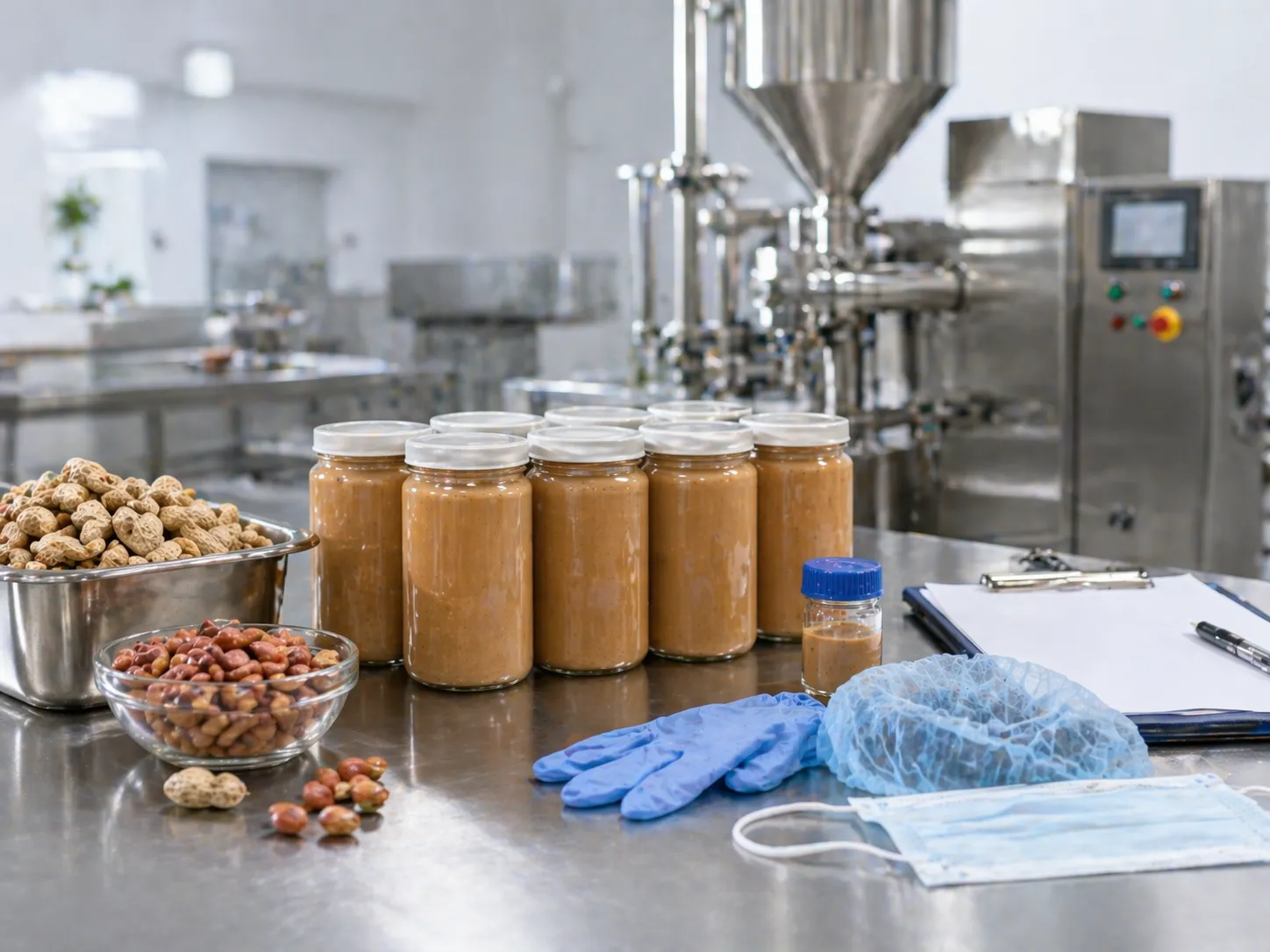
FSSAI compliance is non-negotiable for any peanut butter manufacturer in India. The Food Safety and Standards Authority of India regulates everything from license categories and plant hygiene to labelling, aflatoxin limits and recall procedures. This checklist walks you through every requirement that applies to peanut butter manufacturers in 2026 — so you can launch confidently and pass inspections without surprises.
Step 1: Choose the Right FSSAI License Category
FSSAI offers three license tiers based on turnover and operations scale:
| License Type | Eligibility | Validity | Government Fee |
|---|---|---|---|
| Basic Registration | Turnover < INR 12 lakh/year, manual operations only | 1–5 years | INR 100/year |
| State License | Turnover INR 12 lakh – 20 crore/year, capacity < 2 MT/day | 1–5 years | INR 2,000–5,000/year |
| Central License | Turnover > INR 20 crore/year, OR exporter, OR multi-state operations | 1–5 years | INR 7,500/year |
Most peanut butter manufacturers start with State License. Apply for Central License if you plan to export or operate in multiple states.
Step 2: Documents Required
Keep these ready before applying online at foscos.fssai.gov.in:
- Form B (Application form, signed)
- Photo ID and address proof of proprietor/partners/directors
- Proof of premises (rent agreement / ownership document / utility bill)
- NOC from local municipality / Panchayat
- List of food categories and processing capacity
- List of equipment with capacity (RPM, kW, kg/hour)
- Layout plan of the manufacturing premises (200 sq m for State; 1,000 sq m for Central)
- Source of raw material (peanuts, oils, salt, sugar, stabilisers)
- Water analysis report (potable water source)
- Recall plan
- Food Safety Management System (FSMS) plan
- Form IX (nomination of authorised person) if applicable
- MoA, AoA for companies; partnership deed for firms
Step 3: Plant & Hygiene Requirements (Schedule 4)
Schedule 4 of the FSS Regulations defines mandatory hygiene practices. Inspectors check these during license verification.
Premises & Layout
- Designed to enable smooth flow: raw material intake → cleaning → processing → packaging → despatch (no cross-contamination paths)
- Walls and floors smooth, washable, non-absorbent (epoxy or food-grade tiles)
- Ceiling free from condensation, peeling paint, exposed wiring
- Pest-proofing: insect screens on windows, rodent traps, no gaps under doors
- Adequate ventilation, lighting (200 lux at workstations, 500 lux at inspection points)
- Separate areas for raw material storage, processing, finished goods, packaging materials
Equipment
- Food contact surfaces: SS304 minimum (SS316 preferred for high-salt/acidic mixes)
- No copper, brass, lead, or galvanised surfaces in contact with food
- Equipment design: easy to dismantle, clean and sanitise
- All grinders, mixers, fillers must have CIP (clean-in-place) capability or be CIP-friendly
- Calibration records for weighing scales, temperature sensors
Water Supply
- Potable water tested twice annually (test report kept on file)
- Water used for cleaning equipment must meet IS:10500 drinking water standards
- Separate non-potable water supply for cleaning floors / outside areas (clearly labelled)
Personnel Hygiene
- Annual medical fitness certificate for every food handler
- Hair covers, masks, gloves, food-grade aprons mandatory
- Hand-wash stations with soap, sanitiser, disposable towels at every entry point
- No jewellery, watches or false nails on production floor
- FoSTaC certified Food Safety Supervisor — at least one per shift
Step 4: Aflatoxin & Quality Standards
Aflatoxin contamination is the #1 quality risk in peanut products. Regulatory limits:
| Market | Aflatoxin B1 limit | Total Aflatoxins (B1+B2+G1+G2) |
|---|---|---|
| India (FSSAI) | 5 ppb | 15 ppb |
| EU / UK | 2 ppb | 4 ppb |
| USA (FDA) | — | 20 ppb (action level) |
| Codex Alimentarius | — | 15 ppb |
Practical mitigation:
- Source peanuts with documented aflatoxin test results
- Store raw peanuts at 6–8% moisture, 25°C max (avoid mould growth)
- Reject any lot with visible mould, off-odour or discoloration
- Test every batch before grinding (in-house ELISA or third-party lab)
- Maintain 3-year batch traceability records
Step 5: Labelling Compliance (FSS Packaging & Labelling Regulations, 2011)
Every retail pack of peanut butter must display:
- Brand name and product name (“Peanut Butter — Smooth” / “Crunchy”)
- FSSAI logo + 14-digit license number
- Veg / non-veg symbol (green dot for peanut butter)
- Ingredient list in descending order by weight
- Nutritional information: energy (kcal), protein, carbohydrates (sugar of which), fat (saturated of which), trans fat, sodium per 100 g and per serving
- Net quantity in metric units
- Manufacturer’s name and address (full)
- Best-before date (manufacture date + recommended shelf life)
- Batch / lot number
- Storage instructions (“Store in cool, dry place. Refrigerate after opening.”)
- Allergen declaration: “Contains peanuts. May contain traces of tree nuts, soy, milk.”
- Country of origin
- Customer service contact (helpline / email)
Common labelling mistakes to avoid
- Missing trans-fat declaration (FSSAI mandates “0” if <0.2 g)
- Vague allergen text (must explicitly say “peanuts”, not just “nuts”)
- Wrong placement of veg symbol (must be top-left of front-of-pack)
- Missing FSSAI logo size: minimum 3 mm in any dimension
- Health claims without scientific evidence (“Heart-friendly”, “Boosts immunity”) — these need pre-approval
Step 6: Annual Compliance & Returns
- Form D1: Annual production return — submit by 31 May for previous financial year
- Form D2: Half-yearly return for milk and milk products (not applicable to peanut butter)
- License renewal: apply 30 days before expiry; late renewal attracts INR 100/day penalty
- FoSTaC training: Food Safety Supervisor must renew certification every 2 years
- Internal audit: annual FSMS audit recommended (HACCP-based)
Step 7: Preparing for FSSAI Inspection
- Keep all records (raw material test reports, batch records, water tests, training certificates) in a single audit-ready folder
- Display FSSAI license at the entrance
- Display the Food Safety Display Board (FSDB) — mandatory for restaurants but recommended for manufacturers
- Keep a recall plan documented and tested annually
- Maintain visitor logs and pest-control records
Step 8: Penalties for Non-Compliance
| Violation | Penalty |
|---|---|
| Operating without FSSAI license | Up to INR 5 lakh + imprisonment up to 6 months |
| Sub-standard food | Up to INR 5 lakh |
| Misbranded food | Up to INR 3 lakh |
| Misleading advertisement | Up to INR 10 lakh |
| Unsafe food causing injury | Up to INR 10 lakh + imprisonment |
| Unsafe food causing death | Up to INR 10 lakh + life imprisonment |
Equipment That Helps You Stay Compliant
Compliance starts with the right machines. Food-grade SS304/SS316 construction, sealed material flow, and CIP-ready design make day-to-day FSSAI compliance much easier. Shrijee Nut Company designs every machine to FSSAI standards by default — see our processing plants, grinding equipment, and filling equipment ranges. For the bigger picture on starting a peanut butter business, read our starter guide for Indian entrepreneurs.
Conclusion
FSSAI compliance isn’t a one-time checkbox — it’s an operating discipline built into every batch you produce. Get the foundations right: choose the correct license category, design your plant for hygienic material flow, document everything from raw material testing to operator training, and invest in a robust traceability system.
The financial penalties for non-compliance are heavy (up to INR 10 lakh + imprisonment), but the brand damage from a single aflatoxin recall or labelling violation can be permanent. The good news: every requirement in this checklist is achievable for an SME — and most reputable Indian peanut butter manufacturers we work with pass FSSAI inspections without issues by following these practices from day one. Treat compliance as a competitive moat, not a cost centre. Reach out if you want help designing a compliant plant layout from scratch.
Frequently Asked Questions
Which FSSAI license do I need for a peanut butter manufacturing unit?
Choose Basic FSSAI for turnover under INR 12 lakh/year, State License for INR 12 lakh to 20 crore/year, and Central License for above 20 crore or any export business. Most peanut butter SMEs operate under State License.
How long does it take to get an FSSAI license?
Basic registration takes 7–15 days. State License typically takes 30–60 days including inspection. Central License can take 60–90 days. Apply early — production cannot begin without it.
What is the maximum aflatoxin limit allowed in peanut butter?
FSSAI permits a maximum total aflatoxin level of 15 ppb in peanut butter for direct human consumption. Export markets like the EU, UK and USA require lower limits (4–10 ppb).
Do I need to display the FSSAI logo on peanut butter labels?
Yes. The 14-digit FSSAI license number along with the FSSAI logo must be displayed on every retail pack as per the FSS (Packaging and Labelling) Regulations, 2011.
What are the consequences of selling peanut butter without FSSAI?
Penalties range from INR 5 lakh up to INR 10 lakh, plus possible imprisonment for sub-standard or misbranded products. Retailers and quick commerce platforms also refuse to onboard unlicensed brands.