Peanut Butter Machine Manufacturer in Delhi
Complete peanut butter processing machinery for Delhi NCR — roasters, blanchers, grinders and filling systems in food-grade stainless steel, delivered, installed and commissioned across Delhi, Noida, Ghaziabad, Faridabad, Gurugram and Sonipat.
- Power
- 415V 3-phase, 50Hz standard
- Capacity
- 100 – 1,000+ kg/day
- Construction
- SS304 standard, SS316 optional
- Coverage
- Delhi, Noida, Ghaziabad, Faridabad, Gurugram, Sonipat
- Road Transit
- 2 – 3 days from Rajkot
- Included
- Installation, commissioning & training
Peanut Butter Machines
for Delhi NCR
Delhi does not grow groundnut, but it consumes an enormous amount of what groundnut becomes. The NCR is India’s densest concentration of health-food retail, quick-commerce fulfilment and gym-and-nutrition demand — the exact channels that turned peanut butter from a niche import into a mainstream Indian staple. For a manufacturer, that proximity to demand is the whole argument for producing here.
Shrijee Nut Company manufactures peanut and nut processing machinery at our Rajkot, Gujarat works and supplies plants across Delhi NCR — with more than 500 machine installations and over 100 turnkey projects across 25+ Indian states since 2004. Installation, commissioning and operator training come as standard.
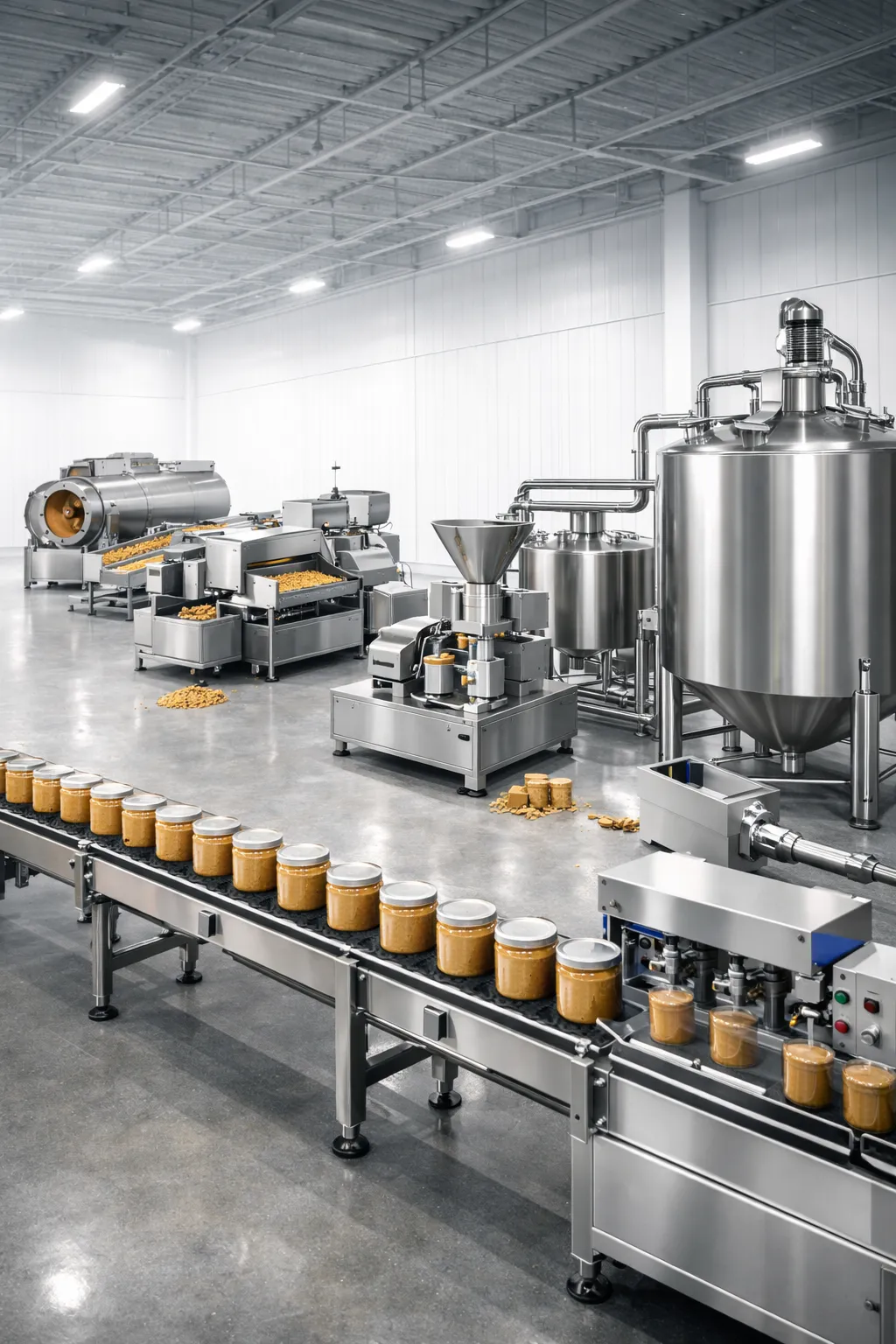
From Raw Groundnut to Filled Jar
Order the full sequence as one integrated package, or individual machines to fill gaps in an existing setup.
Every Machine We Manufacture
Twenty machines across six categories — supplied individually or as a fully integrated line.
Choose Capacity for Your Market
Over-specifying is the most common and most expensive mistake we see. Buy for the demand you can prove, not the demand you hope for.
Starter Line
100–150 kg/dayD2C brand, gym and nutrition retail, quick-commerce listings.
- Compact roaster
- Single-stage grinding
- Semi-automatic filling
- 800–1,200 sq ft footprint
Growth Line
300–500 kg/dayModern trade supply and regional distribution across the northern belt.
- Rotary roaster and cooling belt
- Blanching stage included
- Two-stage grinding
- 2,500–4,000 sq ft footprint
Industrial Line
1,000+ kg/dayContract and private-label manufacturing for multiple brands.
- Continuous roasting
- Automated blanching
- In-line filling and labelling
- Bulk storage tanks
Delhi’s specific dynamic is worth naming. Because the NCR has so many brand owners without plants, contract manufacturing can fill capacity faster than building your own label. If that is your plan, specify for changeover flexibility rather than raw throughput — multiple recipes, smooth and crunchy variants, several jar sizes. A ribbon blender sized for your smallest economic batch matters more here than a larger grinder.
Four Reasons Delhi NCR
Works as a Production Base
Demand Density
The NCR supports modern retail chains, a mature D2C and quick-commerce ecosystem, and a large institutional buyer base in hotels, bakeries and food service. Few Indian markets let a new brand test and iterate this quickly.
Distribution Reach
Delhi is the natural hub for Punjab, Haryana, Uttar Pradesh, Rajasthan and Uttarakhand. A single plant here serves the whole northern belt without needing a second facility.
Private-Label Demand
A large share of NCR peanut butter brands do not own plants. Contract manufacturing for them is often a faster route to profitable utilisation than launching your own label from a standing start.
Ancillary Supply
Jars, caps, labels, cartons and printing are all available locally, which shortens lead times and reduces the working capital tied up in packaging inventory.
Setting Up in Delhi NCR
The order these happen in matters. Load sanction and zoning routinely take longer than machine manufacture.
Confirm Zoning
Verify the premises sits in a notified industrial area before signing any lease.
Registrations
FSSAI, GST, Udyam and the municipal trade or factory licence.
Load & Consent
Apply to BSES or Tata Power for sanctioned load, and to DPCC for consent to establish.
Civil & Electrical
Flooring, drainage and wiring completed against our layout and foundation drawings.
Delivery & Commissioning
2–3 day road transit from Rajkot, then installation and operator training on site.
Apply for load sanction early. We issue a connected-load schedule with every quotation precisely so you can start this before the machines are built. Metering and sanction routinely take longer than manufacture, and it is the most common reason commissioning slips.
Siting a Peanut Butter
Plant in Delhi
This is where Delhi differs most from other Indian cities, and it catches people out.
Delhi restricts manufacturing to notified industrial areas. You cannot set up a food processing unit in residential or general commercial premises — and discovering this after signing a lease is an expensive mistake.
Inside Delhi
Bawana, Narela, Mundka and the Okhla Industrial Area are the commonly used notified zones for food processing. Bawana and Narela offer the most available floor space; Okhla sits closer to central distribution but at a significant premium.
The NCR Alternative
Many manufacturers serving Delhi deliberately locate just outside it — Sonipat, Ghaziabad, Greater Noida or Faridabad. Floor space costs substantially less, power connections are simpler, and state industrial corporations often offer developed plots with utilities already in place.
Space You Will Need
A 100–150 kg/day line needs roughly 800–1,200 sq ft including storage, processing and packing. A 500 kg/day line needs 2,500–4,000 sq ft. Budget separately for a dry, ventilated raw material store — FSSAI inspection will look for it.
Licences for a Delhi Unit
- FSSAI manufacturing licence — State licence for most units; Central licence above the turnover threshold or if you plan to export.
- GST and Udyam (MSME) registration — the latter is what unlocks most subsidy and priority-lending schemes.
- DPCC consent to establish and consent to operate.
- Factory or trade licence from the local municipal authority, plus fire NOC depending on built-up area.
- Legal Metrology packer registration if you sell pre-packaged retail — frequently overlooked, and it governs how your label declares net quantity.
Rules and thresholds change periodically. Treat this as an orientation checklist, not a compliance reference, and confirm the current position with a local consultant. Our guide to FSSAI compliance for peanut butter manufacturers covers the food-safety side in depth.
Power & Load Planning
Delhi runs standard Indian 415V three-phase 50Hz supply, so our machines connect without modification. What needs planning is the sanctioned load. Delhi’s supply is comparatively stable, so a full-capacity generator is usually unnecessary — most units size a backup set to cover grinding and filling only, leaving roasting to grid supply.
| Line capacity | Indicative connected load |
|---|---|
| 100–150 kg/day | 15 – 25 kW |
| 300–500 kg/day | 40 – 60 kW |
| 1,000+ kg/day | 85 – 130 kW |
Sourcing and Delivery
Delhi is a trading and distribution centre, not a growing region. Kernels come in from Gujarat, Rajasthan and Madhya Pradesh, either through Delhi’s wholesale trade or bought directly from processors in the producing states.
- Direct sourcing gives better control over kernel grade and moisture consistency — which matters more than a marginal price advantage, because incoming moisture drives your roast profile.
- A trading hub makes it easy to compare and switch suppliers, a real advantage over plants tied to a single local supply.
- Aflatoxin management starts at intake. Do not delete the sorting table and vibratory sieve to save on the machine list — rejecting kernels at intake is far cheaper than a failed FSSAI test on finished stock.
- Road transit from our Rajkot works is 1,200–1,400 km, typically two to three days once dispatched.
Peanut Butter Machines in Delhi
Yes. We manufacture at our Rajkot, Gujarat facility and deliver across Delhi and the wider NCR including Noida, Ghaziabad, Faridabad, Gurugram and Sonipat. Road transit is approximately 1,200 to 1,400 km and typically takes two to three days once dispatched.
Typically an FSSAI manufacturing licence, GST registration, Udyam (MSME) registration, a factory or trade licence from the local municipal authority, and consent to establish and operate from the Delhi Pollution Control Committee. Delhi restricts manufacturing to notified industrial areas, so confirm zoning before signing a lease. Verify current requirements with a local consultant.
Bawana, Narela, Mundka and the Okhla Industrial Area are the commonly used notified zones for food processing within Delhi. Many manufacturers instead locate in Sonipat, Ghaziabad, Greater Noida or Faridabad, where floor space costs less and power connections are simpler, while staying within reach of Delhi distribution.
Standard 415V three-phase 50Hz. A 100–150 kg/day line typically needs 15–25 kW sanctioned load; a 500 kg/day line generally needs 40–60 kW. We issue a connected-load schedule with every quotation so you can apply to BSES or Tata Power Delhi before the machines arrive.
Yes, across Delhi NCR as part of our standard supply. Training covers roast profiling, grinder gap setting, cleaning and changeover routines, and preventive maintenance. Layout and foundation drawings are supplied ahead of delivery so civil and electrical work can be completed first.
Delhi is a trading hub rather than a growing region, so kernels come from Gujarat, Rajasthan and Madhya Pradesh, either through the wholesale trade or direct from processors in producing states. Direct sourcing gives better control over grade and moisture consistency, which matters more for product quality than a marginal price difference.
Planning a Peanut Butter Plant in Delhi?
Tell us your target output in kilograms per day, your packaging format, whether you need smooth, crunchy or both, and your site location within NCR. We will come back with a machine list, a layout drawing and a firm price.