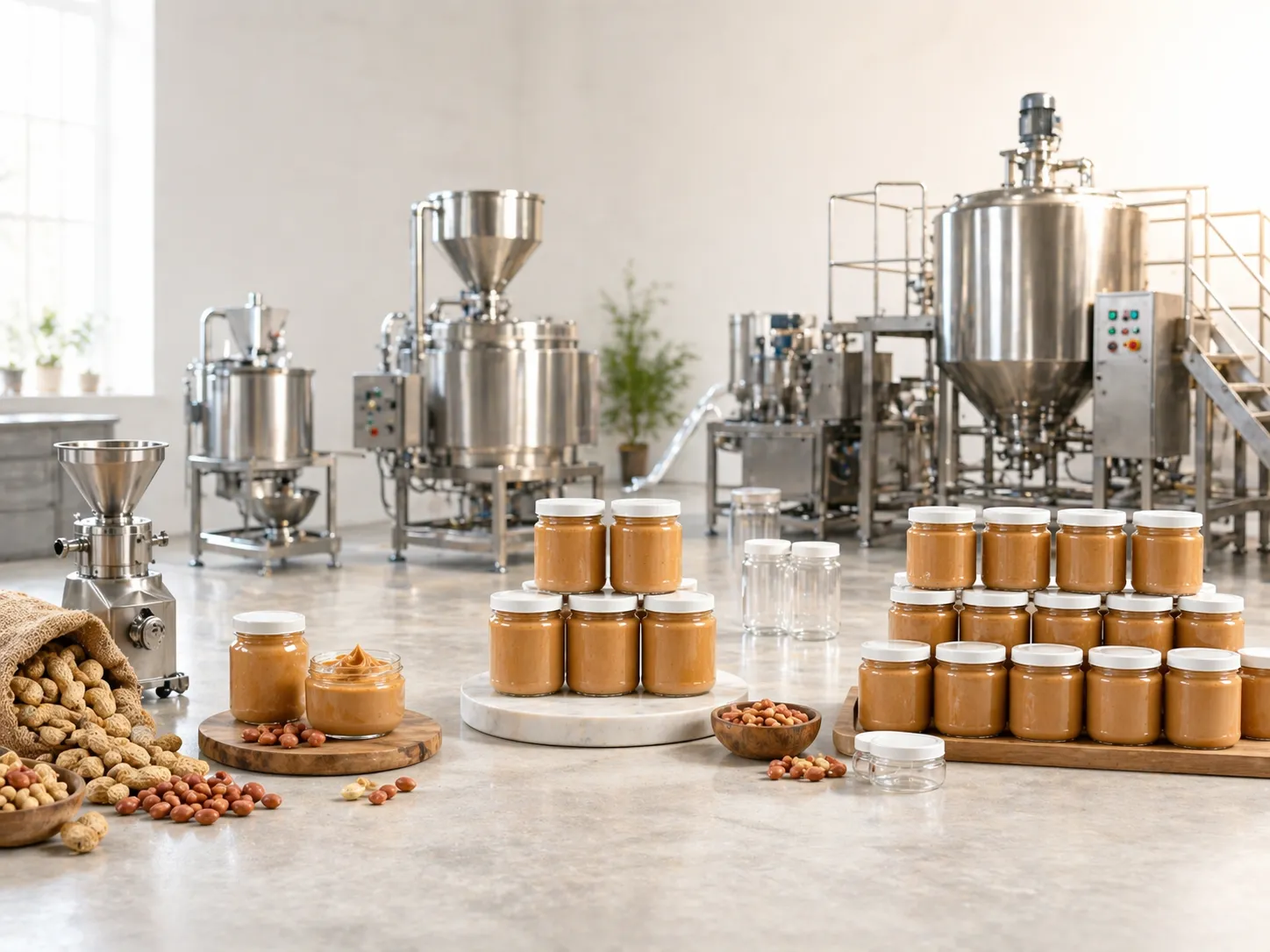
“What does a peanut butter plant actually cost?” is the first question every founder asks — and the answer depends on capacity, automation level, packaging format and how much civil work you’re willing to take on yourself. This breakdown gives you realistic 2026 numbers across three plant sizes so you can budget accurately before talking to suppliers.
Three Plant Sizes, Three Investment Profiles
Most peanut butter manufacturers in India fall into one of three capacity tiers:
- Small unit: 100 kg/day — kitchen-scale, single-product, owner-operated
- Mid-scale plant: 500 kg/day — small SME, 4–8 staff, usually serves regional retail and B2B
- Turnkey plant: 1,000+ kg/day — full automation, in-line QC, exports and large retail chains
Tier 1: Small Unit (100 kg/day)
Designed for entrepreneurs validating a brand or producing for a niche audience. Typical machinery configuration:
| Component | Cost (INR) |
|---|---|
| Drum or small rotary roaster (50 kg/hr) | 1,80,000 – 2,80,000 |
| Manual blanching tray + skin separator | 40,000 – 70,000 |
| Single-stage colloid mill (PBM50) | 2,40,000 – 3,50,000 |
| Stainless steel mixing tank (100 L) | 35,000 – 55,000 |
| Manual / piston filler | 25,000 – 45,000 |
| Machinery subtotal | 5.2 – 8 lakh |
| Civil work + electrical (DIY in shed) | 1 – 2 lakh |
| Initial raw material (1 month) | 1.5 – 2.5 lakh |
| Packaging, labels, jars (10,000 units) | 50,000 – 1 lakh |
| FSSAI + GST + Udyam registration | 15,000 – 30,000 |
| Working capital buffer | 1 – 2 lakh |
| Total investment | 9.4 – 15.8 lakh |
Realistic monthly output: 2,000–2,500 kg at 70–80% utilisation. Monthly revenue: INR 5–7 lakh at INR 240–280/kg wholesale. Net margin: 12–18% after all costs.
Tier 2: Mid-Scale Plant (500 kg/day)
The sweet spot for most growing brands. Adds automation, redundancy and quality consistency.
| Component | Cost (INR) |
|---|---|
| Radiant ray rotary roaster (200 kg/hr) | 5,50,000 – 8,50,000 |
| Cooling belt / cooling tunnel | 1,80,000 – 3,00,000 |
| Whole blancher / split blancher | 3,00,000 – 4,50,000 |
| Sorting table + vibratory sieve | 1,20,000 – 2,00,000 |
| Primary peanut butter machine PBM100 | 3,80,000 – 5,50,000 |
| Secondary micro-cutter grinder | 2,80,000 – 4,20,000 |
| Ribbon blender (100 L) | 1,50,000 – 2,40,000 |
| Storage tanks / SS hoppers | 1,80,000 – 3,00,000 |
| Semi-automatic filling machine | 3,50,000 – 5,80,000 |
| Conveyors + utilities | 1,20,000 – 2,00,000 |
| Machinery subtotal | 26 – 41 lakh |
| Civil work (2,500–3,000 sq ft) | 4 – 7 lakh |
| Electrical, plumbing, drainage | 1.5 – 3 lakh |
| Initial raw material (1 month) | 6 – 10 lakh |
| Packaging, labels (50,000 units) | 2 – 4 lakh |
| Licensing, legal, trademark | 50,000 – 1 lakh |
| Working capital (3 months) | 4 – 8 lakh |
| Total investment | 44 – 74 lakh |
Realistic monthly output: 10,000–12,500 kg at 70–80% utilisation. Monthly revenue: INR 28–38 lakh at INR 280–320/kg blended (retail + B2B + private label). Net margin: 15–22%.
Tier 3: Turnkey Plant (1,000+ kg/day)
Full continuous-flow line with automatic raw-material intake, in-line metal detection, automatic capping/labelling, and PLC-controlled production.
| Cost Block | Range (INR) |
|---|---|
| Complete turnkey machinery package | 50 – 80 lakh |
| In-line metal detector + weight checker | 3 – 6 lakh |
| Automatic capping + labelling line | 5 – 9 lakh |
| Civil work (4,000–5,000 sq ft) | 8 – 15 lakh |
| HVAC, drainage, fire safety | 3 – 6 lakh |
| Initial raw material (1 month) | 12 – 20 lakh |
| Packaging stockpile (1 lakh units) | 5 – 8 lakh |
| Licensing + trademark + IP | 1 – 2 lakh |
| Working capital (3 months) | 10 – 18 lakh |
| Total investment | 97 lakh – 1.64 cr |
Realistic monthly output: 22,000–26,000 kg. Monthly revenue: INR 65–85 lakh blended. Net margin: 18–25% with brand pull.
Hidden Costs Most Buyers Forget
- Stainless steel grade premium: SS304 is standard, SS316 adds 25–35% to vessel costs but is required for export-grade and salt-heavy variants
- Power back-up: A 25–40 kVA DG set adds INR 4–8 lakh; non-negotiable in regions with frequent outages
- Spare parts inventory: Budget INR 1–3 lakh for first-year spares (mill rotors, blanching belts, motors)
- Operator training: Most reputable manufacturers include this free; verify before signing
- Aflatoxin testing setup: In-house mini-lab costs INR 1.5–3 lakh, third-party lab fees run INR 800–1,500 per batch
- Insurance: Plant + product liability typically 0.5–1% of asset value annually
Ways to Reduce Initial Investment
- Lease vs buy land/shed: Industrial sheds in MSME clusters (Rajkot, Pune, Coimbatore) lease at INR 18–35/sq ft/month — defers INR 30–60 lakh of land cost
- Buy refurbished machinery for non-critical units: Sorting tables, conveyors, mixing tanks can be sourced second-hand at 40–60% discount; never compromise on grinders or roasters
- Phased automation: Start semi-auto, upgrade to fully-auto in year 2 once cash flow stabilises
- Subsidies: PMFME (Pradhan Mantri Formalisation of Micro Food Enterprises) offers 35% subsidy up to INR 10 lakh for food processing units
Financing Options Available
| Scheme | Loan Range | Best For |
|---|---|---|
| Mudra Tarun | Up to INR 10 lakh | Small unit (Tier 1) |
| PMEGP | Up to INR 25 lakh (mfg) | Mid-scale (Tier 2) |
| Stand-Up India | INR 10 lakh – 1 cr | SC/ST/women entrepreneurs |
| SIDBI 4E (Energy Efficiency) | INR 10 lakh – 1.5 cr | Energy-efficient turnkey plants |
| Bank term loan + machinery hypothecation | 70–75% of plant value | All tiers |
| NABARD AMI scheme (export units) | Up to 25% subsidy | Tier 3 with export commitment |
ROI & Payback at a Glance
| Plant Tier | Investment | Annual Revenue (80% util.) | Net Profit | Payback |
|---|---|---|---|---|
| 100 kg/day | 10–15 lakh | 60–80 lakh | 8–14 lakh | 14–22 months |
| 500 kg/day | 45–70 lakh | 3.4–4.6 cr | 50–95 lakh | 18–30 months |
| 1,000+ kg/day | 1 – 1.6 cr | 7.8–10 cr | 1.4–2.4 cr | 24–36 months |
These numbers assume healthy raw-material sourcing, efficient operations and steady distribution. New brands building from scratch should add 6–12 months to payback to account for ramp-up.
Get a Customised Quote
Every plant is unique — output target, packaging format, automation level and site constraints all change the final number. Share your plan with our team and we’ll prepare a detailed BOM (Bill of Materials), layout drawing and price quote within 2 working days. Also see our guide on starting a peanut butter business in India for the bigger picture.
Conclusion
The investment required for a peanut butter plant in India spans a wide range — from INR 10 lakh for a kitchen-scale operation to over INR 1.5 crore for a fully turnkey continuous-flow plant — and the right tier depends on your demand certainty, financing capacity and target distribution channels.
Most successful manufacturers we’ve commissioned in the last five years started in the mid-scale tier (INR 45–70 lakh, 500 kg/day) and grew into automation as cash flow permitted. Hidden costs like power back-up, spare parts inventory and aflatoxin testing infrastructure can add 8–15% to the headline number — budget for them upfront. With government schemes like PMFME, PMEGP and Mudra offering meaningful subsidies, the effective capital outlay can be reduced by 25–40% if you qualify. The smartest investments are the ones backed by realistic demand projections — always validate sales channels before signing the machinery PO.
Frequently Asked Questions
What is the minimum investment for a peanut butter plant in India?
The minimum viable peanut butter unit starts around INR 8–10 lakh for a small 30–50 kg/hour setup including a basic colloid mill, manual roasting, packaging supplies and licensing. This suits home-business or kitchen-scale entrepreneurs.
How much does a 500 kg per day peanut butter plant cost?
A semi-automatic 500 kg/day peanut butter plant typically costs INR 35–60 lakh end-to-end including machinery (INR 18–28 lakh), civil work, utilities, packaging and one month of working capital.
How much does a 1,000 kg per day turnkey plant cost?
A fully automatic 1,000 kg/day turnkey peanut butter plant costs INR 80 lakh to 1.3 crore in India depending on automation level, brand of motors, and degree of in-line quality control.
What is the payback period for a peanut butter plant?
Payback typically ranges from 18–30 months for a 500 kg/day plant operating at 70–80% capacity utilisation, assuming healthy retail margins of 25–35% gross.
Can I get a loan for a peanut butter manufacturing plant?
Yes. MSME loans under PMEGP, Mudra (Tarun category up to INR 10 lakh), and Stand-Up India schemes are commonly used. Banks also offer secured term loans up to 70–75% of plant value with 7–10 year tenure.