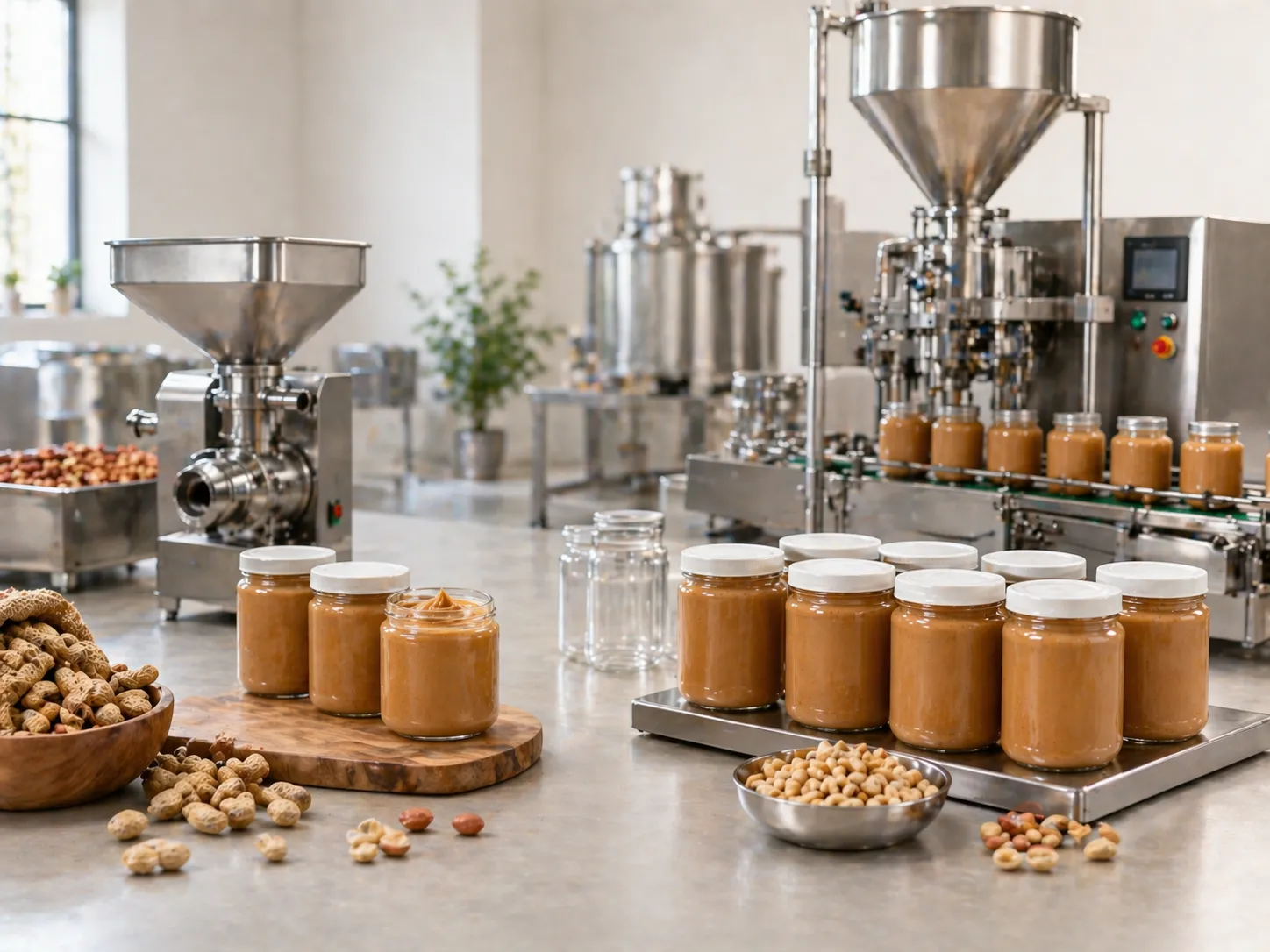
Choosing between a semi-automatic and a fully-automatic peanut butter plant is the single most important capital decision after deciding to enter the business. Pick wrong and you’ll either burn cash on automation you don’t need yet, or hit a throughput ceiling six months after launch. This guide compares both options across the eight dimensions that actually matter — so you can match the plant to your business reality.
What Counts as “Automatic” in a Peanut Butter Plant?
A peanut butter plant has six core production stages. The level of automation refers to how much human intervention is required at each transition between stages.
- Manual: operator handles material transfer, machine controls, and quality checks at every stage
- Semi-automatic: individual machines run automatically once started, but operators load/unload material between stages and switch machines on/off
- Fully-automatic: material flows continuously through the line via conveyors, hoppers and sensors; PLC controls regulate temperatures, speeds and dosing; humans monitor dashboards and handle exceptions
Side-by-Side Comparison
| Parameter | Semi-Automatic | Fully-Automatic |
|---|---|---|
| Investment (500 kg/day) | INR 35–60 lakh | INR 80 lakh – 1.3 cr |
| Floor space | 2,500–3,500 sq ft | 4,000–5,500 sq ft |
| Labour required | 5–8 operators | 2–3 supervisors + 2 packers |
| Labour cost / month | INR 1.2–2 lakh | INR 60,000–1 lakh |
| Power consumption | 22–30 kW | 35–50 kW |
| Production speed | Batch-mode, gaps between stages | Continuous, no gaps |
| Throughput consistency | ±10–15% (operator-dependent) | ±2–4% (sensor-controlled) |
| Batch-to-batch quality variance | Moderate (skill-dependent) | Low (PLC-controlled) |
| Material wastage | 3–6% | 1–2% |
| Setup & commissioning time | 30–45 days | 60–120 days |
| Maintenance complexity | Low — local mechanic | High — trained engineer |
| Spare parts availability | Easy, off-the-shelf | Some imported, longer lead |
| Best for monthly output | 5,000–15,000 kg | 20,000+ kg |
| Payback period | 18–30 months | 24–42 months |
Stage-by-Stage Differences
1. Cleaning & Sorting
Semi-auto: Sorting tables with manual inspection, vibratory sieves for size grading. Operators visually inspect and remove damaged kernels.
Fully-auto: Optical sorters with infrared sensors detect colour and shape defects at 1,500+ kg/hour. Removes 99.5%+ of foreign material without human intervention.
2. Roasting
Semi-auto: Operator manually loads rotary roaster, sets temperature, monitors timer, and unloads to cooling belt. Roast quality depends on operator’s judgement of colour and aroma.
Fully-auto: Continuous-flow roaster with inline temperature sensors. Pre-programmed roasting curves; operator only changes recipes via touchscreen. Cooling belt automatically discharges to next stage.
3. Blanching
Semi-auto: Manually fed whole blancher or split blancher. Skin separation collected in trays.
Fully-auto: Continuous blanching with automatic skin discharge; weight-controlled feed prevents over-stuffing.
4. Grinding
Semi-auto: Operator switches on primary colloid mill, then transfers paste to secondary micro-cutter. Cooling jacket monitored manually.
Fully-auto: Two-stage grinding inline; PLC adjusts feed rate to prevent thermal runaway. Inline particle-size monitoring (laser diffraction) auto-adjusts gap settings.
5. Mixing & Stabilising
Semi-auto: Ribbon blender manually loaded with batch quantities of salt, sugar, stabiliser. Operator visually checks mix homogeneity.
Fully-auto: Volumetric dosing pumps add ingredients per recipe; mixer runs for pre-set time then auto-discharges to filling buffer tank.
6. Filling, Capping & Labelling
Semi-auto: Volumetric filling machine with manual jar placement and capping. Labels applied with separate semi-auto labeller.
Fully-auto: Inline conveyor: jars dispensed automatically → filled → capped → checkweighed → metal-detected → labelled → coded → packed in cases. End-to-end no manual touch.
Total Cost of Ownership Over 5 Years
Comparing a 500 kg/day output target:
| Cost Component | Semi-Auto (5 yr total) | Fully-Auto (5 yr total) |
|---|---|---|
| Capital cost | INR 50 lakh | INR 1 cr |
| Labour (8 vs 4 staff @ INR 18k avg) | INR 86.4 lakh | INR 43.2 lakh |
| Material wastage (4% vs 1.5%) | INR 36 lakh | INR 13.5 lakh |
| Energy | INR 12 lakh | INR 18 lakh |
| Maintenance + spares | INR 6 lakh | INR 14 lakh |
| Quality rejections (returns) | INR 8 lakh | INR 2 lakh |
| 5-year total cost | INR 1.98 cr | INR 1.91 cr |
At 500 kg/day target, total cost of ownership is roughly equivalent over 5 years. Semi-auto has lower upfront risk; fully-auto has lower operating risk. Above 1,000 kg/day, fully-auto becomes decisively cheaper per kilogram produced.
When to Choose Semi-Automatic
- You’re launching a new brand and demand is unproven
- Initial capex must stay under INR 60 lakh
- You want flexibility to switch between smooth, crunchy, salted, sweetened variants frequently
- Local skilled labour is abundant and affordable
- Power supply is unreliable — manual restart is easier
- You plan to start at 300–500 kg/day and grow gradually
When to Choose Fully-Automatic
- You have a confirmed off-take agreement (private label, large retail) above 800 kg/day
- You’re targeting export markets where consistent batch quality is non-negotiable
- You want minimal dependency on operator skill (large-scale hiring is expensive in your region)
- You need premium positioning where uniform colour and texture matter for branding
- You have access to bank financing for higher capex
- You have a long-term plant in a stable location with reliable power
The Hybrid Approach (Most Indian Plants Today)
Roughly 70% of the Indian peanut butter manufacturers Shrijee Nut Company has commissioned in the last 24 months chose a hybrid model: semi-automatic core production line (roasting, blanching, grinding) + fully-automatic filling/capping/labelling line. This balances upfront investment with the high-payoff automation at the packaging end (where speed and accuracy matter most for retail-grade output).
The hybrid model typically runs INR 60–85 lakh and delivers 80% of the throughput of full automation at 60% of the cost.
Quick Decision Framework
- Output < 500 kg/day & capex constrained → semi-auto
- Output 500–1,000 kg/day & mid-budget → hybrid
- Output > 1,000 kg/day & export/retail focus → fully-auto
Talk to a Plant Engineer
Both architectures have served Indian manufacturers well — the right choice depends on your specific demand, financing, location and growth plan. Share your business plan with our team and we’ll model both options against your actual numbers, then recommend the right plant. Also see our companion guide on peanut butter plant cost in India for detailed budget breakdowns.
Conclusion
The choice between semi-automatic and fully-automatic isn’t a binary good/bad decision — it’s a match between your business stage and capital position. Semi-automatic plants give you flexibility, lower upfront risk, and faster cash flow at output levels under 800 kg/day. Fully-automatic plants pay back through scale, consistency and labour savings once you’re processing 1,000+ kg/day with locked-in off-take.
The hybrid model — semi-automatic core with automated filling/capping/labelling — has emerged as the practical sweet spot for most growing Indian peanut butter brands, balancing capex discipline with retail-grade output quality. Whatever path you choose, future-proof the plant: insist on a layout that allows incremental automation upgrades as your business scales. Talk to our team if you’d like a free assessment of which option fits your specific demand and budget.
Frequently Asked Questions
What is the main difference between semi-automatic and fully-automatic peanut butter plants?
Semi-automatic plants require operators to manually transfer material between stages and load/unload jars, while fully-automatic plants use conveyors, sensors and PLC control to handle material flow continuously from raw peanut intake to capped jars without human intervention.
Which is more cost-effective: semi-automatic or fully-automatic?
Semi-automatic plants have lower upfront investment and lower maintenance complexity. Fully-automatic plants cost 2–3x more upfront but pay back through higher throughput and lower labour costs — making them more cost-effective above 1,000 kg/day output.
How many workers does each type need?
A 500 kg/day semi-automatic plant typically employs 5–8 workers. A fully-automatic plant of the same capacity needs only 2–3 supervisors plus 2 packaging staff.
Can I upgrade from semi-automatic to fully-automatic later?
Yes. Most reputable manufacturers design semi-automatic plants with future automation in mind. You can add automatic conveyors, PLC controls and inline QC equipment as cash flow allows.
Which type produces better quality peanut butter?
Fully-automatic plants deliver more consistent batch-to-batch quality through tighter temperature control and automated mixing ratios. Semi-automatic plants can achieve equivalent quality with skilled operators but with more variation between batches.