Key Takeaways
- Vibratory sieve machines ensure precise particle separation and consistent grading for various materials like powders and granules.
- As a Vibratory Sieve Machine Manufacturer in India, we provide customizable configurations to match specific processing needs.
- Understanding mesh size and deck configuration is crucial for optimized screening results in industrial operations.
- Efficient separation capabilities enhance product quality and streamline downstream processing in B2B applications.
- Regular maintenance and easy cleaning access are key features of our vibratory sieves, supporting long-term reliability.
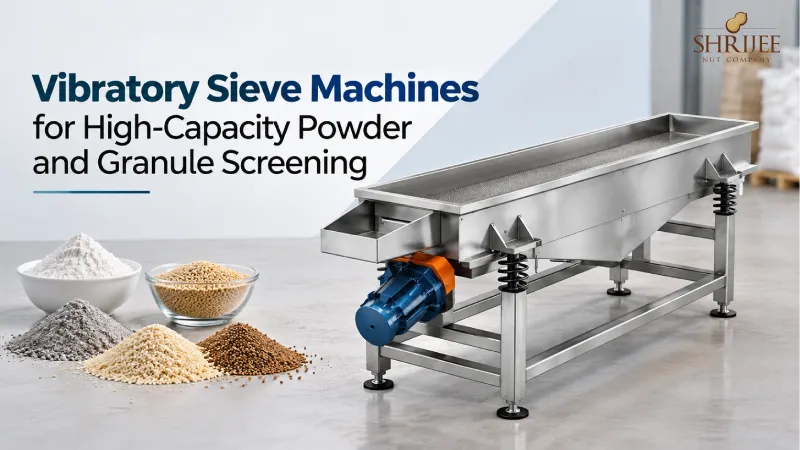
Shrijee Nut Company is a leading manufacturer of vibratory sieve machines for accurate screening, grading, and separation of powders, granules, seeds, and other solid materials.
For B2B processing operations, consistent particle size and effective removal of unwanted material can directly affect downstream processing and finished-product quality. As a Vibratory Sieve Machine Manufacturer in India, we offer screening equipment designed for continuous material separation while supporting high-capacity industrial processing. Our vibratory sieve can be configured according to material type, mesh requirements, and processing needs.
What Is a Vibratory Sieve Machine?
A vibratory sieve, also called a vibro sieve, is used to separate materials according to particle size. Material is introduced onto a screening mesh, where controlled vibration spreads it across the surface. Smaller particles pass through the mesh openings, while larger particles remain above the screen and move toward a separate discharge point.
This operating principle makes the equipment suitable for screening, grading, and removing impurities from powders, granules, seeds, spices, and other compatible materials. The main purpose is to create a more uniform material stream before the next production stage.
For businesses searching for a Vibratory Sieve Machine Manufacturer in India, selecting a machine according to material characteristics and required separation size is particularly important because screening capacity depends on both the material and the chosen mesh size.
How Vibratory Screening Works
The screening process is continuous and follows a straightforward material flow. According to our machine design, the process consists of the following stages:
- Material feeding: Raw or processed material enters through the inlet and is distributed onto the screening surface.
- Vibration activation: The vibratory mechanism generates controlled oscillations that spread material across the sieve mesh.
- Particle separation: Smaller particles move through the mesh openings, while oversized material remains on the screening surface.
- Multi-level screening: When required, multiple mesh decks can separate the material into different size grades during one operation.
- Material discharge: Separated fractions leave through designated outlets for further processing or packaging.
This method supports a stable material flow without making the screening stage unnecessarily complicated.
Key Features for High-Capacity Screening
High-capacity screening requires more than simply increasing material feed. Separation accuracy, mesh configuration, movement across the screening area, cleaning access, and equipment construction all need to work together.
Our vibratory sieve includes features developed around these processing requirements:
- High-precision screening for particle separation and grading
- Controlled vibratory mechanism for continuous operation
- Single, double, or multi-deck configurations
- Multiple customizable mesh options
- Compact structure suitable for processing-line integration
- Easy cleaning access and low-maintenance design
- SS 304, SS 316, or optional high-grade alloy construction
The machine is also described as using circular vibratory screening motion with smooth, noise-controlled operation.
Technical Configuration of the Vibratory Sieve
The correct configuration depends on the product being screened and the required particle classification. Shrijee Nut Company provides customizable construction, mesh sizes, capacity, and deck arrangements rather than presenting one fixed configuration for every material.
| Specification | Available Configuration |
|---|---|
| Construction | SS 304 / SS 316 / optional high-grade alloy |
| Screening Type | Vibratory screening with circular motion |
| Capacity | Customized according to material and mesh size |
| Mesh | Multiple customizable mesh options |
| Deck Configuration | Single / double / multi-deck |
| Main Use | Screening, grading and separation |
This flexibility is useful for B2B buyers because powders, seeds, spices, and granular materials can have substantially different screening behaviour.
Applications Across Powder and Granule Processing
The machine is designed for applications involving food materials, spices, seeds, chemicals, pharmaceutical products, powders, and granules.
A suitable screening system can be used for:
- Separating oversized particles from processed material
- Removing undersized material or unwanted impurities
- Grading products into selected particle-size ranges
- Screening powders before further processing
- Classifying seeds and granular materials
- Preparing a more uniform product stream for subsequent operations
As a Vibratory Sieve Machine Manufacturer in India, our focus is on matching the screening arrangement with the actual production requirement rather than treating every powder or granule in the same way.
Why Mesh Size and Deck Configuration Matter
Mesh selection controls which particles pass through the screening surface and which are retained. A single-deck system may be appropriate where one main separation is required, while double or multi-deck arrangements can divide material into several size grades.
The published machine configuration allows single, double, and multi-deck arrangements together with multiple mesh options. This makes it possible to adapt the screening system around the required separation outcome.
The correct sieve specification should be based on the material, required particle size, desired grading pattern, and production flow.
What B2B Buyers Should Check Before Selecting a Vibratory Sieve
Before finalizing screening equipment, buyers should clearly define their processing conditions. This makes technical discussion more practical and helps identify the appropriate machine configuration.
- ✔ Type of powder, granule, seed, or solid material being screened
- ✔ Required particle or mesh size
- ✔ Expected processing capacity
- ✔ Number of size grades required
- ✔ Single, double, or multi-deck preference
- ✔ Preferred equipment construction material
- ✔ Available space and integration requirements within the processing line
Shrijee Nut Company offers customizable capacity based on material and mesh size, along with different mesh and deck configurations.
Role of Vibratory Sieves in Continuous Processing Lines
A screening machine often works as one stage within a broader processing system. Consistent grading before downstream equipment can create a smoother flow of material and reduce the amount of unsuitable material moving to the next operation.
The compact design of the vibratory sieve is intended for integration with processing lines, while its cleaning access and straightforward construction support routine plant operation.
Businesses comparing a Vibratory Sieve Machine Manufacturer in India should therefore consider not only the sieve itself but also how effectively it can fit into the planned production sequence.
Why Choose Us
At Shrijee Nut Company, we understand that industrial screening requirements vary according to material characteristics, mesh size, capacity, and the required number of separations. Our vibratory sieve is available with SS 304, SS 316, or optional alloy construction, customizable mesh arrangements, and single, double, or multi-deck configurations. We focus on supplying practical screening equipment that can be integrated into food, seed, powder, granule, chemical, pharmaceutical, and related processing operations.
Conclusion
Efficient powder and granule screening depends on accurate particle separation, suitable mesh selection, controlled vibration, and a machine configuration matched to the actual material. A vibratory sieve provides a practical method for screening, grading, and separating powders, seeds, granules, and compatible solid products during continuous processing. When evaluating a Vibratory Sieve Machine Manufacturer in India, B2B buyers should consider capacity requirements, construction material, mesh size, deck configuration, cleaning access, and production-line integration. Choosing the right specification creates a more consistent screening stage and supports reliable downstream processing.
Planning to purchase a vibratory sieve for powder, granule, seed, spice, food, or industrial material screening? Contact Shrijee Nut Company to discuss your material, required mesh configuration, production capacity, and screening application. Our team can help you identify a suitable machine configuration for your processing requirements.
Call: +91 999 896 3963
Email: shrijeenut@gmail.com
Contact us with your application details to discuss a vibratory sieve configuration suited to your production requirements.
Frequently Asked Questions
What is the primary function of a vibratory sieve machine?
The primary function of a vibratory sieve machine is to separate materials based on particle size. It spreads material across a screening mesh using controlled vibrations, allowing smaller particles to pass through while larger ones are retained for further processing.
How does a vibratory sieve machine improve production efficiency?
By ensuring consistent particle size and effectively removing unwanted materials, a vibratory sieve machine enhances the quality of downstream products. This efficient separation process minimizes material waste and helps maintain a smooth flow of production.
What factors should B2B buyers consider when choosing a vibratory sieve machine?
Buyers should consider the type of material being screened, required particle size, processing capacity, and preferred deck configuration. Additionally, the construction material and integration capabilities within the production line are essential for optimal performance.
Why is mesh size important in vibratory sieve machines?
Mesh size is crucial as it determines which particles can pass through during screening and which are retained. The right mesh size ensures accurate separation, contributing to the overall efficiency and effectiveness of the material processing.
What makes Shrijee Nut Company a leading vibratory sieve machine manufacturer in India?
Shrijee Nut Company stands out due to its customizable machine configurations that cater to various materials and production requirements. With options for different construction materials and mesh arrangements, they provide tailored solutions for efficient screening processes.