Key Takeaways
- Scraped Surface Heat Exchangers are essential for processing thick sauces, chocolate, dairy, and viscous products without fouling.
- As a leading Scraped Surface Heat Exchanger machine manufacturer in India, we provide customizable equipment tailored for specific processing needs.
- Continuous scraping minimizes product buildup, ensuring uniform heating or cooling during processing of temperature-sensitive formulations.
- Our Scraped Surface Heat Exchangers feature CIP compatibility, enhancing hygiene and efficiency in food processing environments.
- Key considerations include production capacity, thermal medium, and integration with existing equipment for optimal performance.
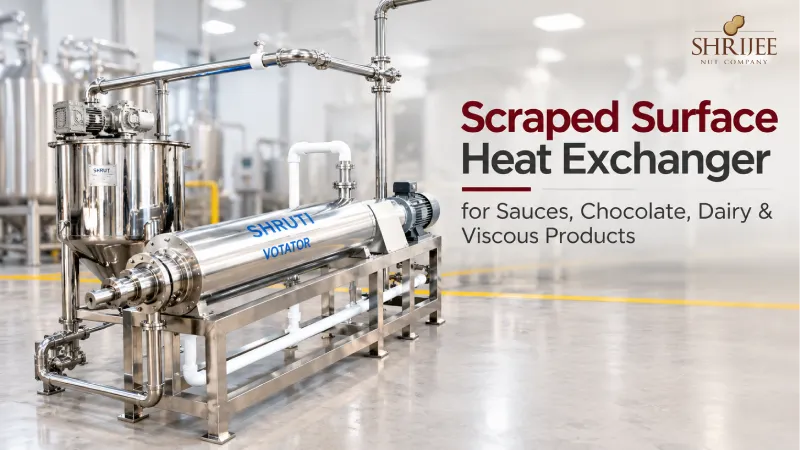
Shrijee Nut Company is a leading manufacturer of Scraped Surface Heat Exchangers for viscous and heat-sensitive food processing applications.
Processing thick sauces, chocolate, dairy products, creams and emulsions requires controlled heat transfer without excessive product buildup on the heating or cooling surface. As a Scraped Surface Heat Exchanger machine manufacturer in India, we provide equipment designed for continuous heating, cooling and crystallization while handling products that are difficult to process through conventional heat exchangers.
Why Viscous Products Need a Scraped Surface Heat Exchanger
Products with high viscosity do not move across heat-transfer surfaces as freely as low-viscosity liquids. Thick sauces, chocolate, creams and similar formulations may remain in contact with a heated or cooled surface for longer periods, increasing the possibility of fouling, burn-on or uneven processing.
A Scraped Surface Heat Exchanger, or SSHE, addresses this problem through rotating scraper blades. These blades continuously remove product from the heat-transfer surface while supporting uniform temperature distribution through the process.
The key advantage is continuous surface renewal during thermal processing, which makes the system suitable for sticky, thick and temperature-sensitive products.
How a Scraped Surface Heat Exchanger Works
The working principle combines controlled product flow, a thermal medium and continuous scraping. Our system is designed to perform heating, cooling or crystallization depending on the required processing application.
The process generally follows these stages:
- Product feeding: The viscous or semi-solid product enters the heat exchanger cylinder through a controlled inlet.
- Thermal exchange: Steam, water, glycol or refrigerant circulates around the jacket to provide the required heating or cooling effect.
- Continuous scraping: Rotating scraper blades remove material from the heat-transfer surface while continuously mixing the product.
- Controlled processing: The product undergoes heating, cooling or crystallization while maintaining a more uniform temperature and texture.
- Product discharge: Processed material leaves through the outlet for the next production, storage or packaging stage.
For B2B food processors seeking a Scraped Surface Heat Exchanger machine manufacturer in India, this working principle is particularly useful when ordinary heat-transfer equipment struggles with sticky or high-viscosity formulations.
Applications in Sauces and Thick Food Products
Sauces can vary significantly in consistency, solids content and temperature sensitivity. A scraped surface system is particularly useful where continuous heat transfer is required without allowing thick material to remain attached to the processing surface.
The machine can efficiently process a range of products, including:
- Thick sauces and food preparations
- Creams and viscous fillings
- Emulsions
- Sticky food formulations
- Products containing suspended or particulate material
The equipment is designed specifically to handle high-viscosity, sticky and particulate materials while limiting buildup on the heat-transfer surface.
Scraped Surface Heat Exchanger for Chocolate Processing
Chocolate requires carefully controlled thermal processing because its texture and physical characteristics are closely related to temperature. A Scraped Surface Heat Exchanger provides continuous scraping and mixing while the product is heated or cooled.
This movement reduces material accumulation on the processing surface and helps maintain more consistent heat transfer throughout production. The manufacturer's product page specifically identifies chocolate among the thick materials the SSHE is designed to process.
When selecting a Scraped Surface Heat Exchanger machine manufacturer in India, chocolate manufacturers should consider required throughput, thermal medium, temperature requirements, cleaning needs and integration with their existing production system.
Use in Dairy and Cream-Based Processing
Dairy and cream-based products can also require controlled temperature management while retaining consistent texture. The SSHE is listed for dairy applications and is designed for food processing where hygienic operation and precise thermal control are important.
A key feature is CIP, or Clean-in-Place, compatibility. This allows the system to be cleaned without routinely dismantling the entire processing assembly, making it practical for food and dairy production environments where regular cleaning forms part of plant operations.
Technical Features for Industrial Processing
Shrijee Nut Company offers its Scraped Surface Heat Exchanger in customizable configurations for different processing requirements. The published technical specifications include capacities from 50 LPH to 10,000 LPH.
| Specification | Available Configuration |
|---|---|
| Material | SS 304 / SS 316 |
| Capacity | 50 LPH–10,000 LPH, customizable |
| Heat Transfer Medium | Steam / Water / Glycol / Refrigerants |
| Temperature Range | -40°C to 150°C |
| Operating Pressure | Up to 10 bar |
| Orientation | Horizontal / Vertical |
The equipment can also be supplied in single-wall, double-wall or insulated construction, with scraper blades available in Teflon or stainless steel configurations. Gear-drive and belt-drive options are listed on the product specification.
Benefits for High-Viscosity Product Processing
The value of an SSHE comes from combining thermal processing with continuous mechanical scraping rather than relying only on product flow.
For industrial users, important benefits include:
- Reduced fouling and product buildup on heat-transfer surfaces
- Uniform heating or cooling across the processing cycle
- Capability to process thick, sticky and viscous formulations
- Heating, cooling and crystallization within suitable applications
- CIP-compatible hygienic construction
- Customizable capacities and equipment configurations
For viscous processing, consistent contact between the product and a clean heat-transfer surface is critical to stable thermal performance.
What B2B Buyers Should Check Before Selecting an SSHE
Before choosing a Scraped Surface Heat Exchanger machine manufacturer in India, buyers should define their actual process conditions rather than selecting equipment only by nominal capacity.
- ✔ Confirm the required production capacity in litres per hour
- ✔ Identify whether the process requires heating, cooling or crystallization
- ✔ Specify product viscosity and whether solids or particulates are present
- ✔ Check the required inlet and outlet temperatures
- ✔ Select the appropriate thermal medium
- ✔ Review available installation space and preferred orientation
- ✔ Discuss CIP requirements and integration with existing equipment
These details help define the configuration required for a specific production line.
Why Choose Us
At Shrijee Nut Company, we focus on practical thermal-processing equipment for demanding food and industrial applications. Our Scraped Surface Heat Exchanger is available in customizable capacities from 50 LPH to 10,000 LPH, with SS304/SS316 construction, horizontal or vertical orientation and multiple heating or cooling media options. We also provide Pan-India installation, commissioning and technical support. As a Scraped Surface Heat Exchanger machine manufacturer in India, we can discuss the machine configuration according to your product and production requirements.
Conclusion
Scraped Surface Heat Exchangers provide an effective thermal-processing solution for sauces, chocolate, dairy products, creams, emulsions and other viscous materials where conventional heat exchangers may experience product buildup or inconsistent heat transfer. Continuous scraper movement helps keep the heat-transfer surface clear while the system performs controlled heating, cooling or crystallization. With customizable capacity, multiple construction options, CIP compatibility and different thermal media, Shrijee Nut Company offers SSHE systems that can be configured around specific industrial processing requirements.
Looking for the right Scraped Surface Heat Exchanger for your sauce, chocolate, dairy or viscous-product processing line? Contact Shrijee Nut Company to discuss your required capacity, application and machine configuration.
Call: +91 999 896 3963
Email: shrijeenut@gmail.com
Send us your processing requirement today and speak with our team about a suitable SSHE configuration for your production line.
Frequently Asked Questions
What is a Scraped Surface Heat Exchanger and how does it work?
A Scraped Surface Heat Exchanger (SSHE) is a specialized device designed for efficient thermal processing of viscous products. It utilizes rotating scraper blades to continuously remove material from the heat-transfer surface, ensuring uniform temperature distribution and preventing product buildup.
Why do I need a Scraped Surface Heat Exchanger for my chocolate processing?
Scraped Surface Heat Exchangers are crucial for chocolate processing as they provide controlled heating and cooling, maintaining consistent texture and quality. The continuous scraping action minimizes the risk of material accumulation and ensures even heat transfer.
What applications can benefit from using a Scraped Surface Heat Exchanger?
SSHEs are ideal for processing thick sauces, chocolates, creams, emulsions, and any other viscous materials. They effectively handle products that require precise temperature control, making them suitable for food processors in various industries.
What should I consider when selecting a Scraped Surface Heat Exchanger machine manufacturer in India?
When selecting a manufacturer, consider production capacity, required heating or cooling processes, product viscosity, temperature specifications, and Clean-in-Place compatibility. These factors will help determine the right configuration for your specific processing needs.
What are the benefits of using a Scraped Surface Heat Exchanger in industrial food processing?
The benefits include reduced fouling and product buildup, uniform thermal processing, versatility in handling sticky and viscous formulations, and CIP compatibility for easier cleaning. This combination enhances efficiency and product quality in food processing.