Key Takeaways
- Start with production capacity planning, not machine selection Always define realistic current and future output needs first, as wrong capacity choice leads to either wasted investment or production bottlenecks.
- A peanut butter line is a complete system, not a single machine It includes roasting, blanching, grinding, mixing, and filling—each stage directly impacts final product quality, texture, and consistency.
- Food-grade build quality and compliance are critical Only SS304/SS316-grade materials with proper hygiene design ensure safety, durability, and approval for commercial and export markets.
- Automation should match business stage and market demand Semi-automatic systems suit startups, while fully automatic lines are better for large-scale or export-oriented production requiring consistency and efficiency.
- Real-world performance and after-sales support matter more than brochures Live plant visits, actual operating data, and strong manufacturer support are essential to avoid breakdowns and ensure long-term profitability.
Peanut butter is no longer the niche health-food product it was ten years ago. Walk into any supermarket in India today and you will find an entire shelf dedicated to it. Parents are buying it for kids' tiffin’s, gym-goers are spooning it straight from the jar, and bakeries, chocolate makers, and HoReCa suppliers are placing bulk orders every week. For anyone planning to enter this market, or scaling up an existing operation, one decision sits above all others, which machine do you actually buy. Get it right and your numbers fall into place.
Get it wrong and you spend the next three years fighting breakdowns, inconsistent texture, and shrinking margins. This guide is a practical walk-through of what to look at and why partnering with a hands-on Peanut butter machinery manufacturer in India like Shrijee Nut Company makes the journey far less painful.
Start With Capacity, Not the Catalogue
Most buyers begin by browsing specification sheets. That is the wrong starting point. Begin with your own numbers instead. How much peanut butter do you realistically expect to sell in month three, month six, and year two? A cottage unit doing 50 to 100 kg a day has very different needs from a mid-sized plant running 500 kg, and again from an export-focused line pushing a tone or more per day. Buy too big and you bleed capital on idle machinery and rent. Buy too small and you hit a wall within months of launch. A safe rule, take your year-one target and add 30 to 40 percent headroom. At Shrijee Nut Company we have installed more than 500 machines across 25 plus states, and the first conversation we have with every client is about getting this number right.
Know That a Peanut Butter Line Is Not One Machine
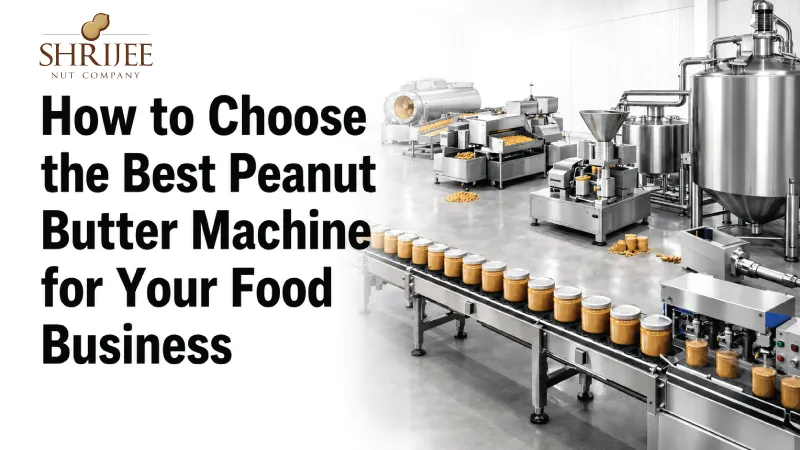
This is where many first-time buyers get tripped up. A peanut butter line is a sequence, cleaning and sorting, roasting, blanching, grinding, mixing, then filling. Each stage has its own machine, and each machine influences the final jar. The roaster, usually a radiant ray rotary type, decides flavor and color. The blancher, whether split, whole, or air based, decides how much skin stays in and how rustic or smooth the butter feels. The grinder is where the actual butter is born, and most serious lines use a two-stage setup with a coarse grinder feeding into a micro-cutting smooth grinder. As a Peanut butter machine manufacturer in India, Shrijee Nut Company builds every machine in this sequence in the same factory, so your line works as one unit instead of a stitched-together mix of suppliers.
Build Quality and Food-Grade Compliance Are Non-Negotiable
Peanut butter is food. Whatever touches it has to behave like food contact equipment. All product-contact parts on your grinders, blanchers, mixers, and fillers should be food-grade stainless steel, SS304 for general contact areas and SS316 where the corrosion load is higher. Welds need to be polished smoothly, dead zones eliminated, and CIP capability built into the critical sections. Plenty of cheap machines in the market cut costs by using mild steel under a thin stainless coating. That trick fails the moment you walk an FSSAI inspector or an export-buyer auditor through your plant. A genuine Peanut butter machinery manufacturer in India will openly share material certificates, welding standards, and surface-finish details. Shrijee Nut Company has been building food-contact machinery since 2004, and every contact surface we make is built to commercial food-grade norms.
Automation Should Match Your Reality, Not the Brochure
There is no universal answer to manual versus automatic. A semi-automatic line keeps your upfront investment lower and works well when local labor is available and affordable. A fully automatic line cuts down dependence on skilled operators, gives more consistent output, and pays back faster wherever labor is expensive, or hygiene audits are strict. The honest way to decide is to look at your location, your customer base, and your three-year growth plan. Exporters and private label suppliers usually have no choice; automation is expected because buyers audit your floor. For a domestic-market entrepreneur just starting out, a semi-automatic line from a reliable Peanut butter machine manufacturer in India is often the wiser starting point, with room to add automation later as volumes grow.
Customization Beats Catalogue Models
Every peanut butter brand has its own personality. Some want chunky butter with visible peanut bits, others want an ultra-smooth spread, some are chasing the health segment with jaggery-sweetened or zero-sugar recipes. Your line needs to handle all of that, not just one recipe at one fixed texture. A rigid machine that runs only one product is a liability the moment your market shifts. Shrijee Nut Company designs custom plant layouts based on your product mix, your floor area, and the power supply you have available, so what you receive is built around your business. This kind of flexibility is one of the real advantages of buying directly from an experienced Peanut butter machinery manufacturer in India rather than going through a trader who is reselling someone else's standard model.
The Real Operating Cost Is Hidden in the Spec Sheet
Brochures list connected load in kilowatts. That figure on its own tells you almost nothing about what the machine costs to run. What you actually want to know is energy consumed per kilogram of finished peanut butter, heat recovery built into the roaster and the heat exchanger, and the downtime between batches. A well-engineered machine from a serious Peanut butter machine manufacturer in India gives you stable output hour after hour with predictable energy use. A poorly designed one spikes consumption and produces uneven batches. Before you sign any purchase order, ask the supplier for actual operating numbers from at least two existing installations.
See a Live Installation Before You Sign Anything
A specification document can be polished. A working installation cannot. Before you finalize any Peanut butter machine manufacturer in India, ask for client references in your own region and try to visit at least one operating plant. Watch the machine run for an hour, talk to the operator, ask about breakdowns over the last twelve months, taste the finished butter. Shrijee Nut Company has installed plants for clients ranging from startups like FreshNut Organics to established players like Nutri Crunch Foods and Golden Harvest Agro Industries, and we are happy to arrange plant visits for serious buyers who want to see the equipment in action.
Why Choose Us
Shrijee Nut Company has been building peanut butter processing machinery since 2004. That is over twenty years in this one category, more than 500 machine installations, 100 plus turnkey projects, and over 1,000 satisfied clients across 25 states in India. Every machine we sell is designed and built in-house at our Rajkot facility, from roasters and blanchers to grinders, ribbon blenders, filling machines, and complete turnkey plants. Because manufacturing, customization, and service all stay under one roof, you get a single accountable partner from the first drawing to the running production line. Our team handles plant layout, installation, commissioning, operator training, and long-term spares support, which is exactly what a food business needs from a machinery supplier over the lifetime of the asset.
Conclusion
Picking the right peanut butter machine is the single biggest decision in setting up a profitable food business in this category. Capacity, build quality, automation, customization, energy efficiency, and after-sales support all carry weight, and skipping any one of them creates problems that only surface once production starts. Working with a trusted Peanut butter machine manufacturer in India with real installations and in-house engineering shifts the risk away from you and places it where it belongs, with the machine builder. Shrijee Nut Company has spent two decades doing exactly that for entrepreneurs and established food brands across the country, and is ready to help you plan, install, and run a peanut butter line built around your business.
Planning to start or upgrade your peanut butter production? Talk to the team at Shrijee Nut Company for honest advice on the right machine for your capacity, budget, and product mix. Call +91 999 896 3963 or email shrijeenut@gmail.com.
Frequently Asked Questions
What is the minimum production capacity I can start a peanut butter business with?
A sensible commercial entry point is around 100 kg per day. It keeps the upfront investment manageable while giving you enough output to serve local retailers, bakeries, and online customers. Shrijee Nut Company can design a line at this capacity and scale it up in stages as your sales grow.
How long does it take to set up a complete peanut butter plant?
For a standard turnkey project, machinery manufacturing usually takes 30 to 60 days, followed by transport, installation, and commissioning at your site. Most plants are production-ready within two to three months from order confirmation, depending on capacity and how prepared your civil work is.
Do I need separate machines for smooth and crunchy peanut butter?
No. The same grinding line can produce both textures by adjusting the grinder settings and the second-stage micro-cutting unit. Our machines are built so the same line can switch between smooth, crunchy, and flavored variants without major changeover.
What certifications should my peanut butter plant comply with?
FSSAI registration is the minimum requirement for selling peanut butter in India. For larger operations, exports, or supplying organized retail and HoReCa, you should plan for FSSC 22000, ISO 22000, and HACCP. Our machines are built to support these compliance levels.
Does Shrijee Nut Company provide installation and training support across India?
Yes. We deliver, install, and commission machinery across all states in India, and our engineers stay on-site for operator training and trial production. Ongoing service and spares are supported by our Rajkot facility for the full lifetime of the machine.