Key Takeaways
- A peanut butter processing line is a complete integrated system Successful production depends on multiple synchronized machines including cleaning, roasting, cooling, blanching, grinding, mixing, filling, and labelling.
- Efficiency directly impacts profitability Low wastage, reduced downtime, energy-efficient operation, and balanced machine capacities are what make a processing line financially successful over time.
- Choosing a single processing line manufacturer reduces operational problems Buying a complete matched system from one manufacturer improves machine compatibility, simplifies maintenance, and ensures single-point accountability.
- Scalable and modular systems support long-term business growth A flexible setup allows manufacturers to start with smaller capacities and expand production later without replacing the entire line.
- Food-grade design and automation improve quality and compliance Stainless steel construction, hygienic engineering, and automation options help maintain consistent product quality while meeting food safety standards for domestic and export markets.
Peanut butter is no longer a niche product on a single shelf. Walk into any supermarket today and you will find rows of jars in different textures, flavors, and price points. Demand keeps climbing because peanut butter has slipped into so many parts of daily life, from morning toast and protein shake to bakery fillings, energy bars, and chocolate spreads. For anyone running a food business, this is good news, but it also raises a simple question. How do you build a production setup that can keep up without breaking down or burning money?
The answer almost always comes back to the equipment behind the scenes. A jar of peanut butter looks simply but getting it from raw ground nuts to a sealed, labelled product takes a long chain of carefully tuned machines. This is where picking the right Peanut butter processing line manufacturer in India changes everything. Shrijee Nut Co. has been working in this exact space for more than twenty years, building lines that range from small 100 kg/hr setups for new brands all the way up to 2000+ kg/hr industrial systems for large manufacturers.
What a Peanut Butter Processing Line Really Is
People sometimes assume a peanut butter line is just one big machine. It is not. It is a sequence of machines, each doing one job, all working in step with each other. If even one stage runs slower or faster than the rest, the whole line suffers. That is why a serious Peanut butter processing line manufacturer spends so much time matching capacities across every section before quoting a single rupee.
It starts with cleaning and sorting. Raw peanuts arrive with stones, soil, dust, broken shells, and the occasional bad kernel. Vibratory sieves and air aspiration handle the bulk of that work, and then operators check the kernels on inspection tables to pull out anything the machines missed. Skip this step and you end up with grit in your final product, off colors, and complaints from your buyers. It is not glamorous, but it is the foundation everything else stands on.
The Stages That Shape Your Final Product
Once the peanuts are clean, they head to the Radiant Ray Rotary Roaster. This is where flavor really develops. Roasting is part science and part art because the time and temperature you pick will decide whether your butter tastes mild and sweet or deep and toasty. Shrijee Nut Co. allows operators to dial in light, medium, or dark roasts depending on the recipe you want to build your brand around.
Roasted peanuts then ride a modular cooling belt to drop their temperature evenly. Skipping properly cooling causes uneven grinding later, so this step matters more than it looks. Cooled peanuts move into the blanching machine, which strips off the red skins and gives you those clean ivory kernels that grind into smoother butter. Depending on what you need, Shrijee offers split blanchers, whole blanchers, and air blanchers.
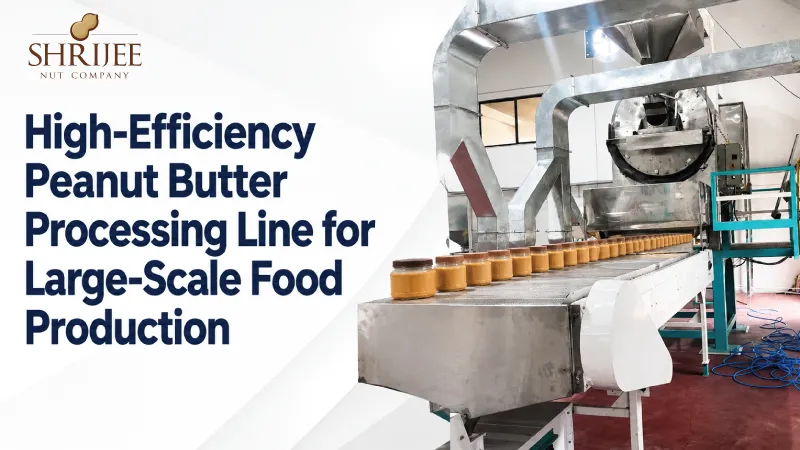
Grinding is where peanuts finally turn into butter. The peanut butter machine and the micro-cutting grinder bring the kernels down to the texture you want, whether that is silky smooth or chunky and crunchy. After that, the ribbon blender folds in salt, sugar, stabilizers, or whatever your recipe calls for. The finished butter then heads to the filling machine, which does each jar accurately, and finally to the labelling machine for retail-ready packaging.
Why Efficiency Decides Whether You Make Money
A lot of new food manufacturers focus only on the purchase price of equipment. That is a costly mistake. The real cost of a processing line shows up later, in wasted raw material, high power bills, slow throughput, and downtime when machines fail. A high-efficiency line keeps all of these costs low and lets you turn raw peanuts into packaged butter with the smallest possible loss along the way.
When buyers try to save money by sourcing different machines from different suppliers, the problems start almost immediately. The roaster might be too fast for the blancher, the grinder might choke the filler, and when something breaks, every vendor blames the other one. A single Peanut butter processing line manufacturer in India like Shrijee Nut Co. removes that headache by supplying the whole line as one matched package. One supplier, one accountability, one phone call when something needs attention.
Built to Grow With You
One thing that makes Shrijee Nut Co. genuinely useful as a Peanut butter processing line manufacturer is how flexible the capacity options are. You can start small with a 100 kg/hr setup if you are launching a fresh brand or running a regional operation. Bigger players moving into export markets often need 2000+ kg/hr, and Shrijee builds for that too. What matters is that the lines are modular, so you do not need to scrap your original investment when you grow. You just add modules and keep going.
This kind of flexibility matters more than people realize. The peanut butter market in India has moved fast in recent years, and a brand that starts in one state can find itself shipping nationally within two or three years. Having a system that scales with you avoids the painful situation of outgrowing your equipment in the middle of a growth phase.
Food Safety Built Into Every Surface
Hygiene is not a feature you add later. It must be incorporated into the design from the beginning. All product-contact surfaces in Shrijee lines are made from SS304 or SS316 stainless steel. These materials resist corrosion, handle aggressive cleaning chemicals, and meet the food safety standards that matter for both Indian and export markets.
The lines are also designed with smooth welds, accessible cleaning points, and proper zoning between raw material and finished product areas. Audits become much easier when your equipment is built with hygiene in mind from the start. If your goal includes export sales where compliance is non-negotiable, this matters even more.
Control Systems That Match Your Reality
Not every manufacturer wants full automation. Some prefer manual control because their batches are smaller or their recipes change often. Others want fully automatic PLC control because they are running long, consistent production days with minimal operator intervention. Shrijee Nut Co. offers manual, semi-automatic, and fully automatic options, which means you pick what fits your team and your budget rather than being pushed into a system that does not match how you actually work.
Smooth and Crunchy on the Same Line
Indian and global consumers want both smooth and crunchy peanut butter, and successful brands usually offer both. Shrijee processing lines handle either type with simple adjustments to the grinder and the mixer. You do not need a second line just to offer a chunky variant, which keeps your investment efficient and your product range wide.
Why Choose Us
Choosing Shrijee Nut Co. as your Peanut butter processing line manufacturer in India means working with a team that has spent more than two decades focused on peanut processing and nothing else. This depth of experience shows up in the smallest details, from how the cooling belts are sized to match the roaster, to how the blanchers feed the grinders without creating bottlenecks. Every line is built as a single integrated system, not a collection of separate machines bolted together, and that approach removes the integration headaches that buyers face when sourcing from multiple vendors. You get food-grade SS304 and SS316 construction across all contact surfaces, scalable capacity from 100 kg/hr up to 2000+ kg/hr, and the choice between manual, semi-automatic, and fully automatic PLC controls. On top of that, Shrijee Nut Co. delivers full turnkey installation, hands-on operator training, and a pan-India service network that keeps your facility running smoothly for years. When you partner with Shrijee Nut Co., you are not just buying machines. You are gaining a long-term production partner who has a real stake in helping your business succeed..
Conclusion
Peanut butter has become a serious commercial category, and the manufacturers who win in this market are the ones who treat their production setup as a strategic asset rather than a one-time purchase. A well-built processing line pays you back every single day through lower waste, better consistency, and higher uptime. Shrijee Nut Co. brings together two decades of peanut processing expertise, complete farm-to-jar integration, scalable designs, food-grade construction, and reliable pan-India support to deliver lines that perform year after year. For any food business serious about growing its peanut butter production, partnering with Shrijee Nut Co. is one of those decisions that quietly pays off across every batch you run.
Want to learn more about choosing the right Peanut butter processing line manufacturer for your factory? Talk to the team at Shrijee Nut Co. directly. Call us at +91 999 896 3963 or email shrijeenut@gmail.com.
Frequently Asked Questions
What production capacities does Shrijee Nut Co. offer?
Shrijee builds processing lines from 100 kg/hr for smaller brands all the way up to 2000+ kg/hr for industrial operations, with modular expansion available as your production grows.
Can the same line produce both smooth and crunchy peanut butter?
Yes. The same line handles both textures with quick adjustments to the grinder and mixer, so you can serve both ends of the market without buying a second setup.
What materials are used in construction, and are they food-safe?
All product-contact surfaces use SS304 or SS316 food-grade stainless steel, which meets the hygiene standards required for both domestic sales and international exports.
Does Shrijee Nut Co. handle installation and operator training?
Yes. Shrijee provides full turnkey service including supply, installation, commissioning, operator training, and ongoing aftersales support through a pan-India service network.
What automation levels are available?
You can pick manual, semi-automatic, or fully automatic PLC control depending on your workforce, budget, and how hands-on you want your operators to be.