Key Takeaways
- Screening and mixing directly impact product quality and consistency Proper screening removes contaminants, while effective mixing ensures every batch delivers the same taste, texture, and quality.
- A layered screening process protects machinery and final products Combining sorting tables, vibratory sieves, and electromagnetic vibrators helps remove stones, dust, defective kernels, and flow disruptions efficiently.
- Ribbon blenders play a critical role in recipe consistency High-quality ribbon blenders evenly mix ingredients like salt, sugar, oils, and stabilizers without damaging product texture or leaving residue behind.
- Integrated systems from one manufacturer improve operational efficiency Matching capacities, synchronized equipment flow, and centralized support reduce downtime, maintenance issues, and production bottlenecks.
- Food-grade construction and customization improve long-term reliability SS304/SS316 stainless steel construction, hygienic design, and flexible customization options help factories meet food safety standards while adapting to different production needs.
Walk into any food factory and ask the owner what causes the most quality complaints. You will rarely hear them blame the big, flashy machines like roasters or fillers. More often the answer comes back to something small that slipped through, or a batch that tasted different from the last one. These problems almost always trace back to two stages that nobody really talks about: screening and mixing. Get this right and your factory runs smoothly. Get them wrong and you spend years patching up issues that should never have existed.
That is why picking the correct Screening and mixing system manufacturer in India is such a big deal. Good screening keeps stones, dust, and bad kernels out of your line. Good mixing makes sure every jar tastes the same as the one before it. Shrijee Nut Co., based out of Rajkot, has been quietly building this kind of equipment for over twenty years. Their range covers sorting tables, vibratory sieves, electromagnetic vibrators, and ribbon blenders, and each piece is designed to work as part of a clean, integrated production flow.
Why Screening Has to Come First
Raw peanuts almost never arrive clean. There will be stones, soil, dust, broken kernels, husks, bits of plant material, and sometimes things you would not even expect, like small metal pieces from harvesting equipment. If any of that reaches your grinder, you are looking at damaged blades, contaminated product, and unhappy buyers. Screening is what stands between your raw material pile and your expensive downstream machines.
The thing is that different impurities need different methods to remove them. Stones drop out one way, dust gets blown away another way, and defective kernels often need a trained operator to spot them. A proper Screening and mixing system manufacturer in India understand this and offers a layered approach instead of relying on one machine to do everything. Shrijee Nut Co. has built its screening range around exactly this logic.
Sorting Tables for the Human Touch
No machine, no matter how advanced, can match a trained operator for catching subtle defects. Some kernels look fine to a sensor, but a human eye picks up the slight discoloration or unusual shape that signals trouble. The sorting table is where this happens. Operators stand at the table while peanuts move past on a steady belt, and they remove anything that does not belong.
Shrijee builds these tables with the operator in mind. The height is right for long shifts, the surfaces are easy to wipe down, and the layout keeps the flow steady without rushing the inspection. For brands selling into premium retail or export channels, this manual check is what separates an average product from a top-shelf one. Shrijee Nut Co. has designed these tables to slot right into the rest of the production line without slowing anything down.
Vibratory Sieves Doing the Heavy Lifting
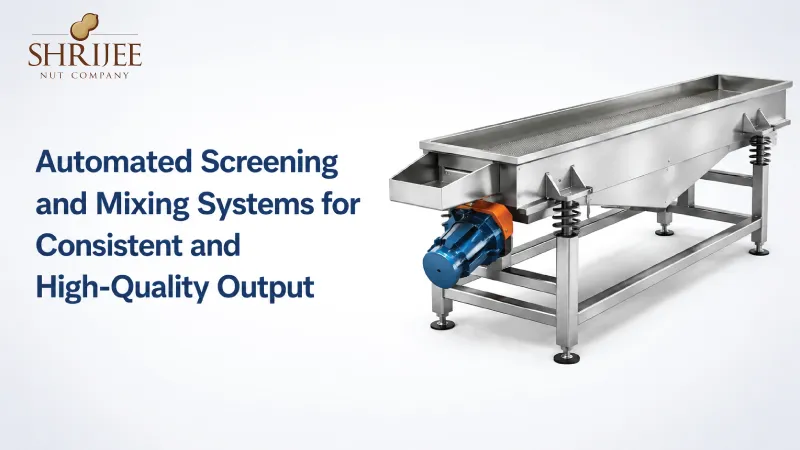
The vibratory sieve handles the bulk cleaning work. Peanuts pour in at one end, the screens vibrate at a controlled frequency, and clean kernels come out the other side while dust, fines, broken bits, and oversized debris drop into reject chutes. Different mesh sizes can be fitted depending on what you want to keep, and the vibration intensity can be tuned for different material conditions.
What you really want to look at when choosing a vibratory sieve is the build quality. Cheap sieves wear out quickly, have unbalanced motors that shake themselves loose, and use screens that tear after a few months. Shrijee uses food-grade stainless steel construction, properly balanced drives, and screens with the right tension. As a serious Screening and mixing system manufacturer, the company has refined these designs through hundreds of installations, fixing the small annoyances that lower-cost machines never seem to address.
Electromagnetic Vibrators That Keep Things Moving
Material flow between stages might sound like a small thing, but it quietly causes a lot of trouble in factories. If peanuts do not move smoothly from one stage to the next, you get surges, then jams, then gaps in the flow, which throws off downstream equipment. Electromagnetic vibrators solve this by giving you steady, controllable vibration on hoppers, feeders, and chutes.
These units are compact and have no rotating parts, so wear is minimal. They quietly do their job for years, keeping material flowing at a regular pace. Across a full shift, this kind of steady performance adds up to noticeable productivity gains. You stop fighting fires and start running clean batches.
Ribbon Blenders for Even Mixing
After grinding, most peanut butter recipes call for adding salt, sugar, stabilizers, palm oil, or some natural sweetener. The trick is mixing all of this evenly, so the first jar of the batch tastes the same as the last jar. This is where the ribbon blender does its work. Shrijee builds these blenders with double helical ribbons that move material in two directions at once, which creates a thorough blend much faster than a single-action mixer.
A good ribbon blender is more than just stirring. It controls shear so delicate ingredients do not break down, handles temperature properly during longer mixes, and discharges them cleanly without leaving residue behind. Shrijee Nut Co., as a focused Screening and mixing system manufacturer in India, builds these blenders using SS304 or SS316 contact surfaces, sanitary discharge valves, and access points that make cleaning quick. All of this matters for FSSAI and export-grade production.
Why These Machines Work Better Together
The real benefit of a complete screening and mixing setup shows up when all the equipment comes from one supplier. In a typical factory, raw peanuts first hit the vibratory sieve to remove fines and stones, then travel to the sorting table for manual checking. Electromagnetic vibrators keep the flow steady into the roaster or blancher. Later, after grinding, the ribbon blender takes over and finishes the recipe before filling.
When all these machines come from the same Screening and mixing system manufacturer, the integration problems just disappear. Capacities match each other, controls speak the same language, and when something needs attention, you have one phone number to call. Shrijee Nut Co. has spent two decades perfecting this matched approach, and you can see the difference on the factory floor.
Hygiene Built Into Every Surface
Modern food factories cannot treat hygiene as an afterthought, especially with FSSAI rules getting stricter and export markets demanding documented compliance. Every screening and mixing unit from Shrijee is built with food-grade stainless steel on contact surfaces, smooth welds without hidden crevices, and cleaning access points that actually make sense. Audits become much less painful, and daily cleaning takes less time. Less downtime for cleaning means more hours producing finished products, which is what every factory owner wants.
Built to Fit How You Actually Work
No two factories run exactly the same way. Some push high volume with one or two recipes, while others run smaller batches across multiple product variants. A few clients work with unusual raw materials that need special configurations. This variability is taken into consideration when designing its screening and mixing equipment, which allows for customization in terms of capacity, mesh size, mixing volume, discharge style, and degree of automation. You get a machine built around your operation, not the other way round.
Why Choose Us
Picking Shrijee Nut Co. as your Screening and mixing system manufacturer in India means working with a team that has been focused on peanut and food processing machinery for more than twenty years. The whole range, from sorting tables and vibratory sieves to electromagnetic vibrators and ribbon blenders, is built under one roof at the Rajkot facility. This means quality stays consistent, customization moves faster, and you are never left behind chasing different suppliers for parts of the same project. All product-contact surfaces use food-grade SS304 or SS316 stainless steel, and the equipment is designed around hygiene principles that hold up to FSSAI audits and export-grade requirements. Beyond just delivering machines, Shrijee handles installation, commissioning, operator training, and long-term service through a pan-India support network. The team also designs each unit to plug cleanly into the rest of your production line, which removes the headaches that come from mixing equipment from different brands. When you go with Shrijee Nut Co., you get reliable engineering, a real long-term relationship, and machines that just work the way they should.
Conclusion
Screening and mixing are the quiet workhorses of a food factory. They do not get the attention that roasters and fillers do, but they shape the quality of every batch you put out. Clean raw material protects your downstream machines, and uniform mixing keeps your customers coming back because the taste stays exactly the same every time. Shrijee Nut Co. brings together two decades of experience, in-house manufacturing, food-grade construction, and reliable pan-India support to deliver screening and mixing systems that hold up year after year. Whether you are setting up a new line or upgrading sections of an existing one, going with Shrijee Nut Co. is one of those decisions you will quietly thank yourself for.
Want to know more about choosing the right Screening and mixing system manufacturer in India for your factory? Call us at +91 999 896 3963 or email shrijeenut@gmail.com.
Frequently Asked Questions
What products are part of Shrijee Nut Co.'s screening and mixing range?
The range covers sorting tables, vibratory sieves, electromagnetic vibrators, and ribbon blenders. Each one handles a specific job in cleaning, material flow, or blending in a typical food line.
Are the machines built from food-grade materials?
Yes. All contact surfaces use SS304 or SS316 food-grade stainless steel, which meets the hygiene standards needed for FSSAI compliance and export-grade production.
Can the equipment be customized to suit my factory?
Absolutely. Shrijee designs each unit around your production volume, mesh size, mixing capacity, automation preference, and available floor space. Standard models are also available if your needs match them.
Do you handle installation and operator training?
Yes. Shrijee Nut Co. provides complete installation, commissioning, and hands-on operator training so your team can run and maintain the equipment confidently from the first day.
Is service support available across India?
Yes. Shrijee runs a pan-India service network that takes care of spare parts, preventive maintenance, and technical assistance throughout the working life of your equipment.