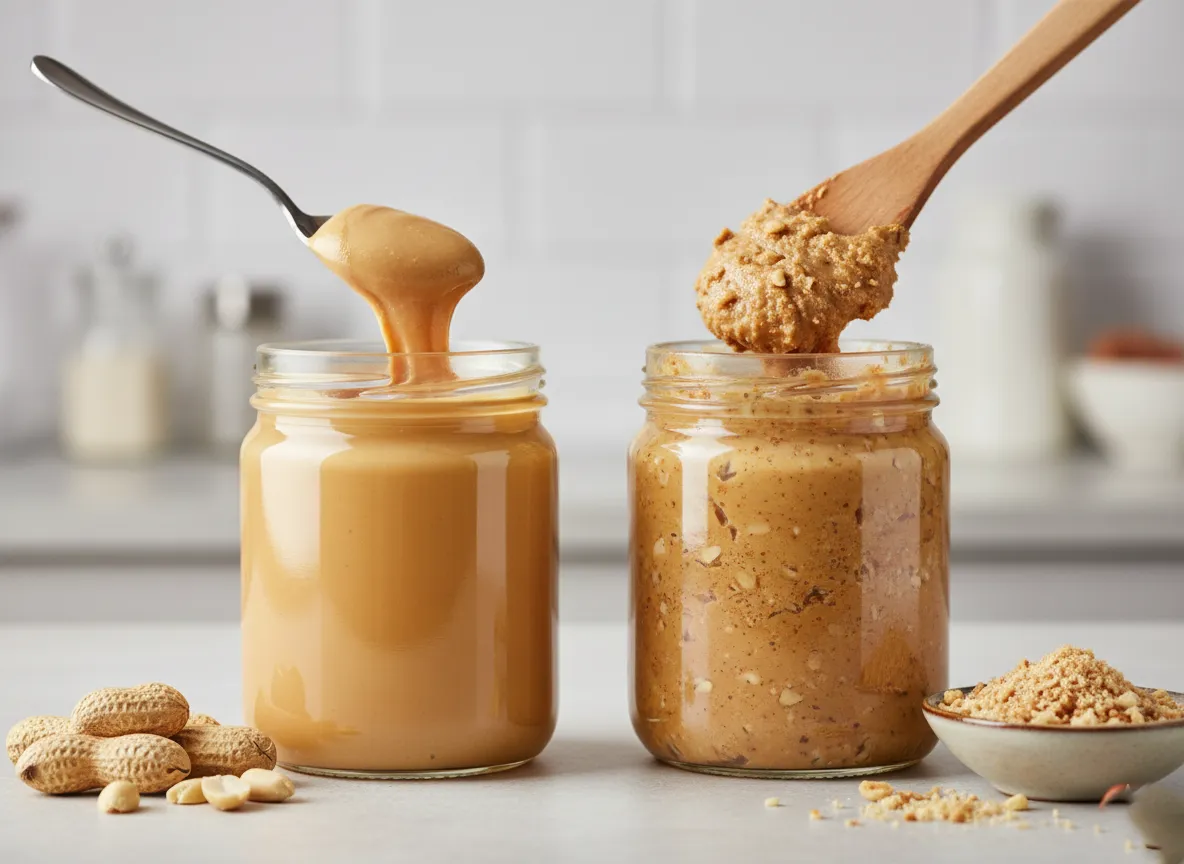
Smooth and crunchy are the two textures that define the peanut butter category — and the difference between them comes down to one variable: particle size. Smooth peanut butter is uniformly ground to a creamy paste; crunchy is the same paste with controlled-size peanut chunks blended back in. Get the machine setup right and you can produce both variants on the same line with zero quality compromise. Get it wrong and you’ll either produce gritty smooth butter or crunchy butter where the chunks settle to the bottom of the jar.
What “Smooth” and “Crunchy” Mean Technically
| Parameter | Smooth | Crunchy |
|---|---|---|
| Base paste particle size | < 30 microns | < 30 microns (same as smooth) |
| Added granule size | None | 1.5–4 mm |
| Granule weight ratio | 0% | 8–18% |
| Spreadability | Excellent | Good (slightly resistant) |
| Mouth-feel | Creamy, uniform | Smooth base + distinct chunk bite |
| Premium positioning | Mass-market favourite | 5–10% retail price premium |
The Smooth Peanut Butter Production Line
Smooth peanut butter requires a two-stage grinding setup to achieve sub-30-micron particle size without overheating the paste (peanut oil starts breaking down above 80°C).
Stage 1: Primary Grinding (Colloid Mill)
The primary peanut butter machine (PBM50/100/200) is a colloid mill with a rotor and stator that grind roasted, blanched peanuts into a coarse paste at 60–80 microns particle size.
- Rotor speed: 2,800–3,000 RPM
- Gap setting: 50–80 microns
- Throughput: 30 kg/hr (PBM50), 80–120 kg/hr (PBM100), 150–220 kg/hr (PBM200)
- Cooling: water-jacketed body keeps paste below 60°C
- Output: coarse peanut paste with detectable graininess
Stage 2: Secondary Grinding (Micro-Cutter)
The secondary micro-cutter grinder takes the primary paste and refines it down to 15–30 microns through closer rotor/stator gap and higher shear.
- Rotor speed: 2,900–3,600 RPM
- Gap setting: 15–30 microns
- Throughput: matches or slightly exceeds primary
- Cooling: mandatory; jacketed cooling with chilled water
- Output: ultra-smooth, glossy paste indistinguishable from international premium brands
Stage 3: Mixing & Stabiliser Addition
The ribbon blender homogeneously mixes salt (1–2%), sugar (0–6%), and stabiliser (hydrogenated vegetable oil 1.5–2.5% in non-natural variants). Optional honey, palm oil, or molasses can be added at this stage.
Stage 4: Filling, Capping & Labelling
Hot peanut butter (45–55°C) flows from the blender to the filling machine. Filling at 50°C improves flow into jars and reduces air entrapment. Cool to ambient, label, and pack.
The Crunchy Peanut Butter Production Line
The crunchy line uses the same smooth-base process but adds two extra steps:
Step 5a (parallel): Granulator / Dicer
A peanut granulator / dicer processes a separate batch of roasted, blanched peanuts (without grinding into paste) and cuts them into uniform 1.5–4 mm fragments.
- Rotor speed: 800–1,200 RPM (much slower than grinders)
- Cutting blades: stainless steel, food-grade, sharp edges to avoid crushing
- Mesh / sieve: 2.5 mm or 3 mm aperture (defines granule size)
- Throughput: 50–150 kg/hr
- Output: uniform peanut granules with minimal fines
Step 5b: Sieving
Granules pass through a vibratory sieve with 1 mm and 4 mm screens. Sub-1 mm fines are returned to the smooth-paste line; oversized chunks (above 4 mm) are re-cut. This delivers a tightly controlled granule size distribution that won’t settle.
Step 6: Granule Addition in Blender
Sieved granules are added to the smooth base in the ribbon blender at 8–18% by weight, depending on the variant:
- Light Crunch: 8–10% granules
- Standard Crunchy: 10–14% granules
- Extra Crunchy / Chunky: 15–18% granules
Mix at low speed (30–50 RPM) for 8–12 minutes. Higher speeds break the granules; longer times don’t improve homogeneity.
Critical Production Parameters
Roasting Profile (same for both)
- Temperature: 160–175°C
- Time: 25–40 minutes (depends on kernel size)
- Target colour: Hunter L value 45–50 for medium roast, 38–42 for dark roast
- Moisture after roasting: 1.5–2.5%
Temperature Control During Grinding
This is where most operators go wrong. Peanut butter heats up rapidly during grinding due to friction. If paste exceeds 80°C:
- Oil separates and migrates to the surface
- Roasted flavour notes degrade
- Texture becomes unstable in storage
Use chilled water (12–18°C) in jacket cooling. If paste temperature creeps above 65°C, slow the feed rate by 20–30%.
Storage Tanks Between Stages
SS304 jacketed storage tanks hold paste between grinding stages. Maintain 35–45°C in storage to keep paste flowable but not overheated. Agitator at 20–30 RPM prevents oil separation.
Common Defects & Fixes
| Defect | Cause | Fix |
|---|---|---|
| Gritty smooth peanut butter | Secondary grinder gap too wide; only one grinding stage used | Add secondary grinder; reduce gap to 20–25 microns |
| Oil separation in jar | No stabiliser; high storage temperature; overheated paste during grinding | Add 1.5–2% stabiliser; cool paste below 60°C; store at 18–25°C |
| Granules sinking in crunchy | Granules too large (> 4 mm); paste viscosity too low | Use sieve aperture 3 mm or below; reduce paste temperature at filling |
| Bitter taste | Over-roasting; aflatoxin contamination; rancid oil | Reduce roasting temperature; test raw material; rotate FIFO inventory |
| Pale colour | Under-roasting; insufficient time at peak temperature | Extend roast by 5–8 minutes; verify thermometer calibration |
| Inconsistent batch quality | Manual operation, no temperature logging | Add inline temperature sensors with chart recorder; document SOPs |
Switching Between Smooth and Crunchy on the Same Line
Most Indian peanut butter manufacturers run smooth in the morning and crunchy in the afternoon — or smooth on Monday/Wednesday/Friday and crunchy on Tuesday/Thursday/Saturday. The changeover is straightforward:
- Finish current variant; flush blender and filler with 5–10 kg of incoming variant’s base paste
- Sanitise granulator + sieve before crunchy run (or after, before next smooth run)
- Adjust filler nozzle bore: crunchy needs 18–22 mm bore; smooth runs fine at 12–16 mm
- Change label reels and batch codes
Total changeover: 30–45 minutes. Minimal downtime, no equipment swap.
Recommended Machine Configuration for Mixed Production
| Machine | Purpose | Smooth | Crunchy |
|---|---|---|---|
| Radiant Ray Rotary Roaster | Roasting | ✓ | ✓ |
| Cooling Belt | Post-roast cooling | ✓ | ✓ |
| Whole Blancher | Skin removal | ✓ | ✓ |
| PBM Primary Grinder | Coarse grind | ✓ | ✓ |
| Micro-Cutter Grinder | Fine grind | ✓ | ✓ |
| Peanut Granulator | Crunchy granules | — | ✓ |
| Vibratory Sieve | Granule sizing | — | ✓ |
| Ribbon Blender | Mixing | ✓ | ✓ |
| SS Storage Tank | Paste holding | ✓ | ✓ |
| Filling Machine | Jar filling | ✓ | ✓ |
The granulator and a dedicated vibratory sieve are the only additional machines for crunchy production — about INR 3.5–6 lakh added to a smooth-only setup.
Talk to Our Plant Engineers
If you’re planning to launch with both variants from day one — or upgrade an existing smooth-only line to add crunchy — Shrijee Nut Company can recommend the right granulator capacity to match your existing throughput. Get a layout sketch and quote within 2 working days. For broader plant-setup advice, see our guides on starting a peanut butter business and semi-automatic vs fully-automatic plants.
Conclusion
Producing both smooth and crunchy peanut butter from a single line is straightforward once your equipment configuration matches the targets — sub-30 micron particle size for smooth, controlled 1.5–4 mm granules at 8–18% loading for crunchy. The two-stage grinding setup is non-negotiable for premium smooth butter; skipping the secondary grinder always shows up as gritty texture in consumer feedback.
For crunchy, the granulator and dedicated sieve are modest additional investments (INR 3.5–6 lakh) that unlock a 5–10% premium SKU and a more diverse product portfolio. The most common defects — overheated paste, oil separation, granules sinking — are all solvable with proper temperature control and stabiliser dosing. Get the machine setup right once, document the SOPs, and your operators can run consistent batches indefinitely. Talk to our engineers for a setup recommendation tailored to your output mix.
Frequently Asked Questions
What is the difference between smooth and crunchy peanut butter at the production level?
Smooth peanut butter is ground to particle sizes below 30 microns through a two-stage grinding process. Crunchy peanut butter has the same smooth base but with 8–18% added peanut granules ranging from 1.5 to 4 mm.
Can the same machine produce both smooth and crunchy peanut butter?
The grinding line is identical for both. Producing crunchy requires one additional machine — a peanut granulator/dicer — and a ribbon blender to mix the granules into the smooth base.
What particle size makes peanut butter "smooth"?
Indian consumers expect smooth peanut butter with particle sizes below 30 microns. Premium ultra-smooth varieties target below 20 microns. Particles above 50 microns produce a noticeably gritty texture.
How much crunch (granules) should crunchy peanut butter contain?
Standard crunchy peanut butter contains 8–12% granules by weight. Extra-crunchy variants go up to 15–18%.
Which is more profitable to produce — smooth or crunchy?
Crunchy commands a 5–10% retail premium but costs slightly more due to the extra granulator step. Net margin difference is small — let consumer demand in your market drive the production mix.