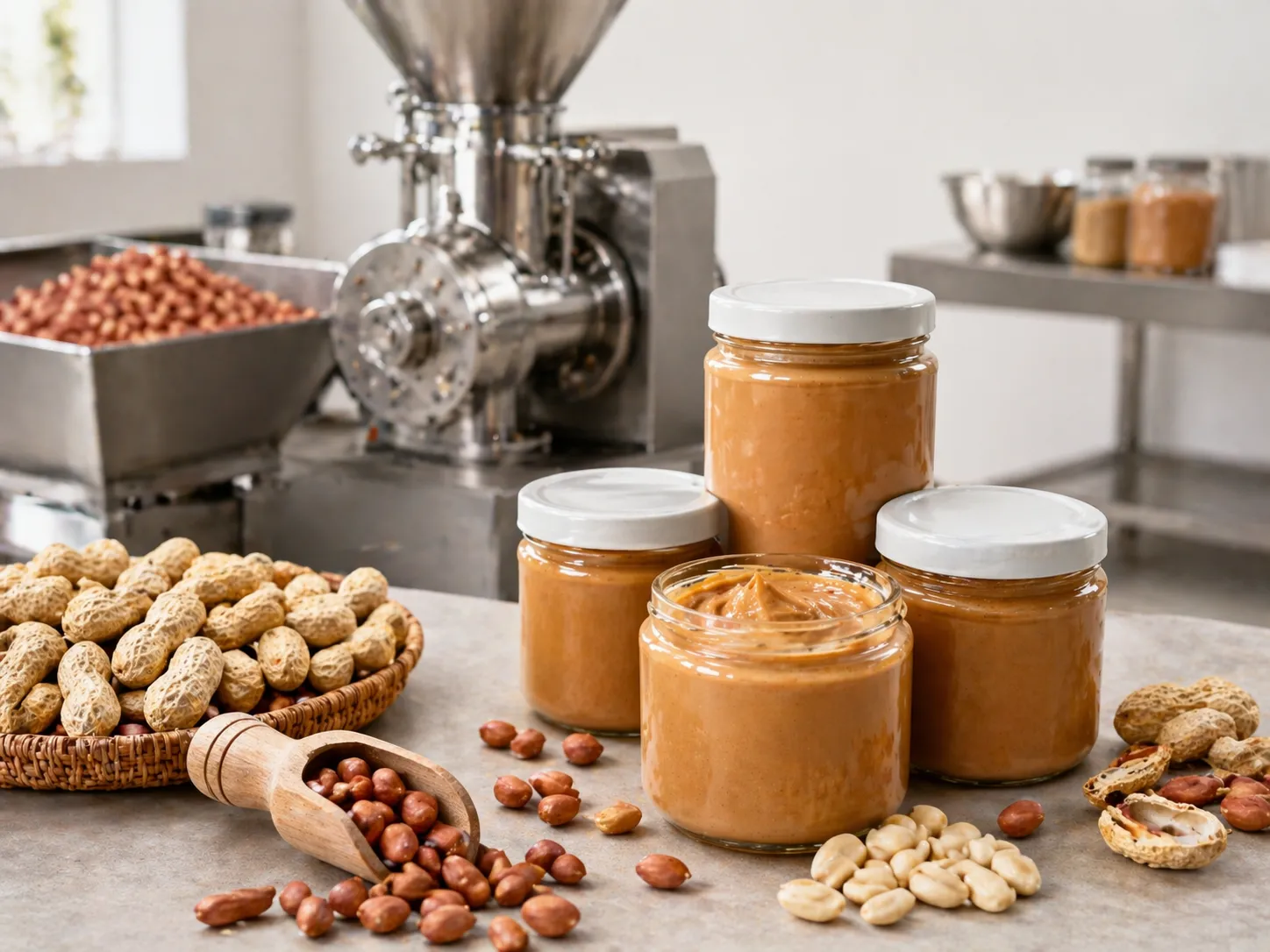
India’s peanut butter market crossed INR 1,200 crore in 2024 and is projected to grow at 18–22% CAGR through 2030, fuelled by fitness culture, retail penetration and the shift toward high-protein breakfast staples. For entrepreneurs sitting on Gujarat’s and Andhra Pradesh’s peanut belts, manufacturing peanut butter is one of the most accessible food-processing ventures to launch in 2026.
This guide walks you through every stage — market validation, business model, capital required, licensing, plant setup, machinery selection and unit economics — so you can move from idea to first production run with confidence.
1. Validate Your Business Model First
Three viable paths exist for peanut butter manufacturing in India:
- Own brand (D2C / retail): Highest margins (20–35%) but heavy marketing investment. Suits founders with a brand-building budget of INR 10–20 lakh in year one.
- Private label / contract manufacturing: You produce for established brands. Margins thinner (8–15%) but order volumes are predictable and marketing cost is zero. Best entry point for first-time manufacturers.
- B2B bulk supply: Selling 10–20 kg buckets to bakeries, hotels, sweet shops and food-service kitchens. Low marketing cost, asset-light, margins 10–18%.
Most successful Indian peanut butter manufacturers start with a hybrid model: B2B + contract manufacturing in year one to cover fixed costs, then layer on an own-brand SKU once cash flow is stable.
2. Capital Required: Realistic Numbers
| Component | Small Unit (50 kg/hr) | Mid-Scale Plant (500 kg/day) | Turnkey Plant (1,000 kg/day) |
|---|---|---|---|
| Machinery | INR 4–6 lakh | INR 18–28 lakh | INR 45–70 lakh |
| Civil work + utilities | INR 1–2 lakh | INR 4–7 lakh | INR 8–15 lakh |
| Initial raw material (1 month) | INR 1.5–2.5 lakh | INR 6–10 lakh | INR 12–20 lakh |
| Packaging & labels | INR 50,000–1 lakh | INR 2–4 lakh | INR 5–8 lakh |
| Licenses & legal | INR 25,000–50,000 | INR 50,000–1 lakh | INR 1–2 lakh |
| Working capital | INR 1–2 lakh | INR 4–8 lakh | INR 10–18 lakh |
| Total | INR 8–15 lakh | INR 35–60 lakh | INR 80 lakh – 1.3 cr |
For deeper numbers see our companion guide on peanut butter plant cost in India.
3. Licenses & Registrations You Cannot Skip
- FSSAI License — Basic (turnover < INR 12 lakh), State (12 lakh–20 cr), or Central (> 20 cr / exporters). Most peanut butter units start with State-level. See our full FSSAI compliance checklist.
- Udyam (MSME) Registration — free, online, unlocks subsidies and priority-sector loans.
- GST Registration — mandatory if turnover crosses INR 40 lakh (services) / INR 20 lakh in special states.
- Trade License — issued by your local municipal corporation.
- Factory License (Factories Act 1948) — required if you employ 10+ workers with power or 20+ without.
- Pollution Control NOC — required in some states for food processing units.
- Trademark — file early; protects your brand name and label design.
4. Choose the Right Manufacturing Setup
Peanut butter production has six core stages: cleaning & sorting, roasting, blanching (skin removal), grinding, mixing & stabilising, and filling & packaging. The machines you buy depend on your target output, automation preference, and budget.
Small-scale (manual / semi-auto, 50–100 kg/hr)
- Drum or rotary roaster
- Manual blanching tray + small blancher
- Single-stage colloid mill / peanut butter machine
- Manual filling — jars filled by hand under a piston filler
Mid-scale (semi-automatic, 300–500 kg/day)
- Radiant ray rotary roaster with cooling belt
- Automatic split blancher or whole blancher
- Two-stage grinding: primary colloid mill + secondary micro-cutter grinder for ultra-smooth texture
- Ribbon blender for salt, sugar, stabiliser addition
- Semi-automatic volumetric filling machine
Large-scale (fully automatic, 1,000+ kg/day)
Best handled as a turnkey plant with continuous-flow design, in-line metal detection, and automatic capping/labelling. See our detailed semi-automatic vs fully-automatic comparison for help choosing.
5. Sourcing Raw Material — Quality is Everything
The single most expensive ingredient is the peanut. Indian peanut butter producers typically source bold/Java/TJ kernels from Gujarat (Junagadh, Rajkot, Jamnagar), Andhra Pradesh (Anantapur), and Karnataka. Key quality parameters:
- Aflatoxin level: < 15 ppb for FSSAI compliance, < 10 ppb for export markets
- Moisture: 6–8% for storage, dried to 2–3% post-roasting
- Foreign matter: < 0.5%
- Broken kernels: < 5% for premium butter, up to 15% acceptable for budget grades
Lock in two or three reliable suppliers — single-source dependency is the most common cause of production downtime in year one.
6. Production Process at a Glance
- Cleaning & sorting — remove stones, dust, damaged kernels (sorting table + vibratory sieve)
- Roasting — 160–180°C for 25–45 minutes; develops flavour, colour, aroma
- Cooling & blanching — rapid cooling, then mechanical skin removal
- Grinding — primary mill + secondary micro-cutter; controls smoothness
- Mixing — add salt (1–2%), sugar (0–8%), stabiliser if non-natural variant
- Filling & capping — into PET jars, glass jars or bulk pails
- Labelling, batch coding, packaging — final QA and despatch
7. Pricing & Profitability
| Cost Component (per 1 kg jar) | Typical Cost (INR) |
|---|---|
| Raw peanuts (1.15 kg) | 105–125 |
| Salt + stabiliser + sugar | 3–8 |
| Packaging (jar + cap + label) | 18–30 |
| Energy + labour + overheads | 15–22 |
| Depreciation | 5–8 |
| Total cost | 146–193 |
| MRP / wholesale | 240–380 |
| Gross margin | 30–45% |
After distributor margin (15–25%) and retailer margin (15–25%), the manufacturer’s realised margin typically lands at 15–25% net.
8. Sales Channels in 2026
- Modern trade: Reliance Smart, DMart, Spencer’s — long payment cycles but volume
- Quick commerce: Blinkit, Zepto, Instamart — high velocity, competitive price points
- Marketplaces: Amazon, Flipkart, BigBasket — table-stakes for D2C brands
- Own D2C site + Instagram — best margins, requires brand-building investment
- HORECA (hotels, bakeries, cafes) — bulk 5/10/20 kg pails, sticky relationships
- Export — Gulf, Africa, Southeast Asia; needs FSSAI Central + APEDA
9. Common Mistakes to Avoid
- Buying machinery before validating sales channels — leaves you with unsold inventory
- Skipping aflatoxin testing — single bad batch can wipe out a brand
- Under-investing in labels and packaging — peanut butter is a visual purchase
- Choosing the cheapest equipment — downtime costs more than the savings
- Ignoring shelf-life testing — natural peanut butter without stabiliser separates within weeks
10. Your Next Steps
If you’ve validated demand and are ready to build, the fastest path is to engage a manufacturer who can supply machines, provide layout drawings, install on-site, and train your operators. Shrijee Nut Company has commissioned 100+ peanut butter plants across India and exports to UAE, Kenya, Nigeria and South Africa. Talk to our team for a customised proposal based on your target capacity and budget.
Conclusion
Starting a peanut butter manufacturing business in India in 2026 is one of the most accessible paths into the high-growth food processing sector. With initial investment ranging from INR 10 lakh for a small unit to INR 1.3 crore for a fully turnkey plant, capital requirements scale with ambition — but margins remain healthy across all sizes.
The key success factors are simple: validate your distribution channel before buying machinery, secure consistent raw material supply with documented aflatoxin testing, get the right FSSAI license category early, and choose machinery from a manufacturer who provides installation, training and reliable after-sales support. With the Indian peanut butter market projected to nearly triple by 2030, the entrepreneurs entering now have a five-year window to build defensible brand equity. Use this guide as your launch roadmap, and reach out for help wherever you need expert guidance on plant setup.
Frequently Asked Questions
How much does it cost to start a peanut butter business in India?
A small-scale unit with a 50–100 kg/hour machine can start around INR 8–15 lakh including basic machinery, FSSAI license, packaging and initial raw material. A fully turnkey 500 kg/day plant typically requires INR 35–60 lakh depending on automation level.
Is peanut butter manufacturing profitable in India?
Yes. Net margins for branded peanut butter typically range 15–25% at retail and 8–15% for private label, driven by rising health-food demand and India’s strong domestic peanut supply.
Which licenses do I need to manufacture peanut butter in India?
FSSAI license (Basic, State or Central depending on turnover), GST registration, Udyam (MSME) registration, factory license under the Factories Act, and pollution control consent if your municipality requires it.
How much space is needed for a peanut butter plant?
A small unit requires 800–1,200 sq ft. A 500 kg/day turnkey plant typically needs 2,500–4,000 sq ft including raw-material storage, processing area, packaging zone and finished goods storage.
How long does it take to set up a peanut butter plant?
From order placement to commissioning is typically 45–90 days for standard machines and 90–150 days for a fully turnkey plant including civil work, machinery installation, and operator training.