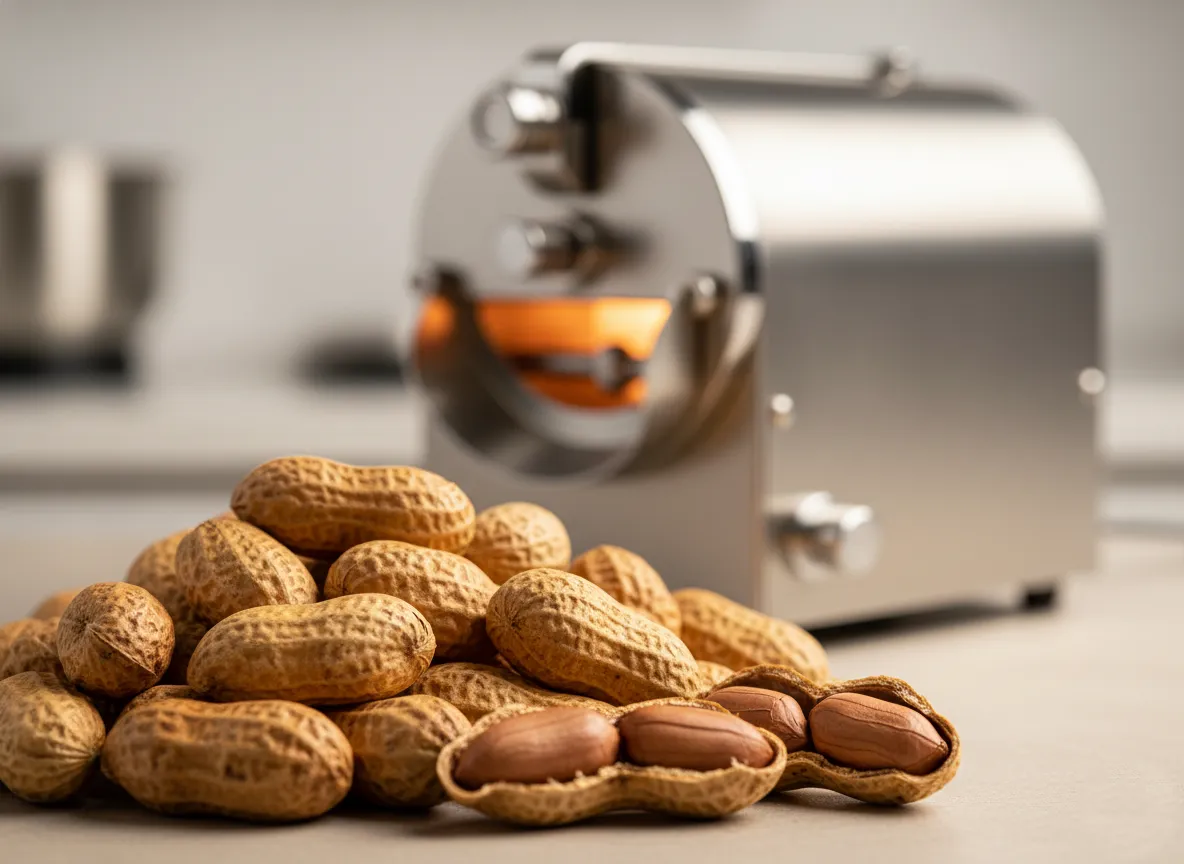
Roasting is the most underestimated step in peanut butter production. Get it right and you build the deep, nutty, caramelised flavour profile that defines a great-tasting product. Get it wrong and no amount of fine grinding or premium packaging can save the batch. The roaster you choose — drum, fluid-bed, hot-air, or radiant ray rotary — determines flavour consistency, energy cost, and material yield. This guide explains why radiant ray rotary roasters have become the preferred choice for serious Indian peanut butter manufacturers.
What Happens Chemically During Roasting
Roasting transforms a raw peanut from a starchy, grassy-tasting kernel into the rich, complex flavour that consumers recognise. Three reactions drive this:
- Maillard reaction: amino acids and reducing sugars combine at 140°C+ to produce hundreds of flavour compounds (pyrazines, furans, thiophenes) responsible for that “roasted nut” aroma
- Caramelisation: sugars in the kernel start browning at 160°C, deepening colour and adding sweetness
- Lipid oxidation: fatty acids partially oxidise to release nutty volatiles — but excessive oxidation creates rancidity
The challenge: every kernel in the batch must reach roughly the same temperature for the same duration to develop uniform flavour. Uneven roasting produces some over-roasted (bitter) and some under-roasted (grassy) kernels in the same batch. The grinder then mixes them into one paste — and the average flavour is mediocre.
How Radiant Ray Rotary Roasting Works
A radiant ray rotary roaster combines two heat transfer mechanisms:
- Radiation: infrared emitters (gas-fired or electric) above and below the drum transmit heat via electromagnetic waves at wavelengths around 2–4 microns. These wavelengths penetrate the peanut kernel rather than just heating its surface — so the inside of the kernel cooks at the same time as the outside.
- Mechanical rotation: the drum tumbles at 4–8 RPM, constantly exposing every kernel to the infrared field. No kernel sits in one position long enough to scorch.
The result: temperature uniformity within ±2°C across the batch, compared to ±8°C in a typical drum roaster.
Comparison: Roasting Technologies Side by Side
| Parameter | Drum (Direct Fire) | Hot Air / Fluid Bed | Radiant Ray Rotary |
|---|---|---|---|
| Heat transfer mode | Conduction (drum wall) | Convection (hot air) | Radiation + tumbling |
| Temperature uniformity | ±8°C across batch | ±5°C | ±2°C |
| Surface vs core cooking | Surface roasts faster than core | Surface cooks first; core lags | Surface and core cook together |
| Roasting time | 40–60 min | 20–30 min | 25–40 min |
| Energy use (per kg) | 0.45–0.55 kWh equivalent | 0.35–0.45 kWh | 0.30–0.40 kWh |
| Yield (after blanching) | 92–94% | 93–95% | 95–97% |
| Smoke generation | High (burnt skin) | Moderate | Low |
| Operator skill needed | High | Medium | Low (recipe-based) |
| Capital cost (200 kg/batch) | INR 4–6 lakh | INR 6–9 lakh | INR 5.5–8.5 lakh |
| Maintenance complexity | Low | Medium (blower, filters) | Low–Medium (emitters) |
| Footprint | Compact | Larger (cyclone, blower) | Compact |
Why Yield Matters More Than Headline Capacity
If a drum roaster yields 93% and a radiant ray yields 96%, that 3% difference is enormous over 12 months:
- Plant capacity: 500 kg/day, 25 days/month, 12 months = 150,000 kg input/year
- Drum roaster yield: 139,500 kg roasted output
- Radiant ray yield: 144,000 kg roasted output
- Difference: 4,500 kg/year extra finished peanut butter
- At INR 280/kg wholesale: INR 12.6 lakh additional revenue annually — pays back the roaster premium in less than a year
Flavour Quality — What Customers Actually Notice
Blind taste tests with peanut butter manufacturers consistently rank radiant ray-roasted batches higher on three attributes:
- Intensity: deeper, more rounded nutty flavour because every kernel develops the full Maillard profile
- Sweetness: uniform caramelisation produces consistent natural sweetness without bitterness from over-roasted hotspots
- Aftertaste: cleaner finish — no scorched-skin notes that occur when peanuts touch a hot drum wall
For brands competing on premium positioning, this flavour difference is a genuine selling point. Several Shrijee Nut Company clients who switched from drum to radiant ray reported reduced consumer complaints about “bitter” or “burnt” flavour within the first month.
Energy & Operating Cost Savings
A radiant ray rotary roaster typically uses 15–25% less energy per kg of output than a drum roaster of the same capacity. Annual savings for a 500 kg/day plant:
- Energy difference: ~0.12 kWh/kg saved × 150,000 kg/year = 18,000 kWh saved
- At INR 9/kWh industrial tariff: INR 1.6 lakh/year energy savings
Combined with yield gains, total annual benefit can exceed INR 14 lakh — meaningful for any SME peanut butter manufacturer.
Integrated Cooling — A Critical Step Most Operators Skip
Roasting only ends when the kernel temperature drops below 60°C. If hot peanuts sit in a tray for 15+ minutes after discharge, residual heat continues the Maillard reaction — and the “roast” you targeted at 170°C effectively becomes 175°C+. Result: darker colour, more bitter notes, less control.
A modular cooling belt integrated with the radiant ray roaster discharges roasted kernels onto a perforated conveyor with forced ambient air drawn from below. Within 4–6 minutes, kernel temperature drops to under 35°C — locking in the targeted flavour profile.
How to Set Up a Radiant Ray Roaster for Different Roast Levels
| Roast Level | Temperature | Time | Peanut Colour (Hunter L) | Best For |
|---|---|---|---|---|
| Light | 160–165°C | 25–30 min | L = 50–55 | Natural / no-additive peanut butter, snack roasts |
| Medium | 170–175°C | 30–35 min | L = 45–50 | Mainstream smooth/crunchy peanut butter |
| Dark | 175–180°C | 35–45 min | L = 38–42 | Premium artisan, dark-roast variants, restaurant supply |
Most Indian brands target medium roast for mass market and offer dark roast as a premium SKU. Recipe is saved on the roaster’s control panel; operator just selects the recipe and presses start.
Versatility — Roasting Beyond Peanuts
The same radiant ray rotary roaster can process other nuts and seeds with adjusted profiles:
- Cashews: 130–140°C / 18–25 min
- Almonds: 140–155°C / 20–28 min
- Pistachios: 130–145°C / 20–25 min
- Sesame seeds: 135–150°C / 12–18 min
- Sunflower seeds: 145–160°C / 18–25 min
This versatility is valuable for plants planning to expand into other nut butters (almond butter, cashew butter) or sesame products (tahini) without buying a second roaster.
Maintenance & Operating Best Practices
- Clean the infrared emitters monthly — soot accumulation reduces heat transfer efficiency
- Inspect drum bearings quarterly; lubricate as per manufacturer schedule
- Calibrate temperature sensors every 6 months (essential for FSSAI / batch consistency)
- Clear the discharge chute daily to prevent skin / debris buildup
- Replace emitters every 18,000–24,000 hours of operation (typical lifespan)
- Keep a spare set of belts for the cooling conveyor — 2-day downtime if one tears
Talk to a Roaster Specialist
If you’re evaluating roasting technology for a new plant or thinking about replacing an underperforming drum roaster, Shrijee Nut Company can model the yield and energy savings for your specific output target. Explore our radiant ray rotary roaster range or request a demonstration video and quote. For broader equipment context, see our guide on choosing between semi-automatic and fully-automatic plants.
Conclusion
Roasting is the foundation of peanut butter flavour quality — and the roaster you choose locks in (or limits) your product ceiling for years. Radiant ray rotary roasters deliver three measurable advantages over traditional drum and hot-air roasters: tighter temperature uniformity (±2°C vs ±8°C), 2–3 percentage points higher yield post-blanching, and 15–25% lower energy consumption.
For a 500 kg/day plant, those gains translate to roughly INR 14 lakh in additional annual benefit — typically paying back the technology premium within 12 months. Beyond the numbers, the consistent flavour profile from radiant ray roasting earns better consumer feedback and lower complaint rates, which compound into stronger brand equity over time. If you’re building a new plant or replacing an underperforming roaster, radiant ray rotary technology is the highest-ROI upgrade in the entire peanut butter production line. Request a demonstration video and quote to evaluate the fit for your operation.
Frequently Asked Questions
What is a radiant ray rotary roaster?
A radiant ray rotary roaster combines infrared (radiant) heat transfer with mechanical rotation. Peanuts tumble inside a rotating drum while infrared emitters transfer heat by radiation rather than direct contact, producing more uniform roasting than traditional drum or hot-air roasters.
How is a radiant ray roaster better than a drum roaster?
Radiant ray roasters deliver more uniform colour and flavour because infrared heat penetrates each kernel evenly. They also reduce energy use by 15–25% and produce less burnt-skin smoke compared to drum roasters.
What temperature is used in a radiant ray rotary roaster?
Standard roasting temperature ranges from 160°C to 180°C depending on desired colour and flavour intensity. Light roasts: 160–165°C; medium: 170–175°C; dark: 175–180°C.
What is the typical capacity of a radiant ray rotary roaster?
Capacities range from 100 kg to 500 kg per batch. A 200 kg/batch roaster delivers approximately 350–400 kg/hour of finished roasted peanuts at a typical 30–35 minute cycle.
Can a radiant ray roaster handle other nuts besides peanuts?
Yes. The same machine roasts almonds, cashews, pistachios, hazelnuts and sunflower seeds with adjusted temperature and time profiles. Sesame and quinoa roasting also works well at lower temperatures.